We hype up our favorite bands; We critique on sports and cars; We opine about pop culture. On occasion, will do some creative writing. This is PATHOLOGICAL HATE. Follow us on Twitter: @pathological_h8
Showing posts with label Blog Post. Show all posts
Saturday, January 14, 2023
Devil's Tramping Ground
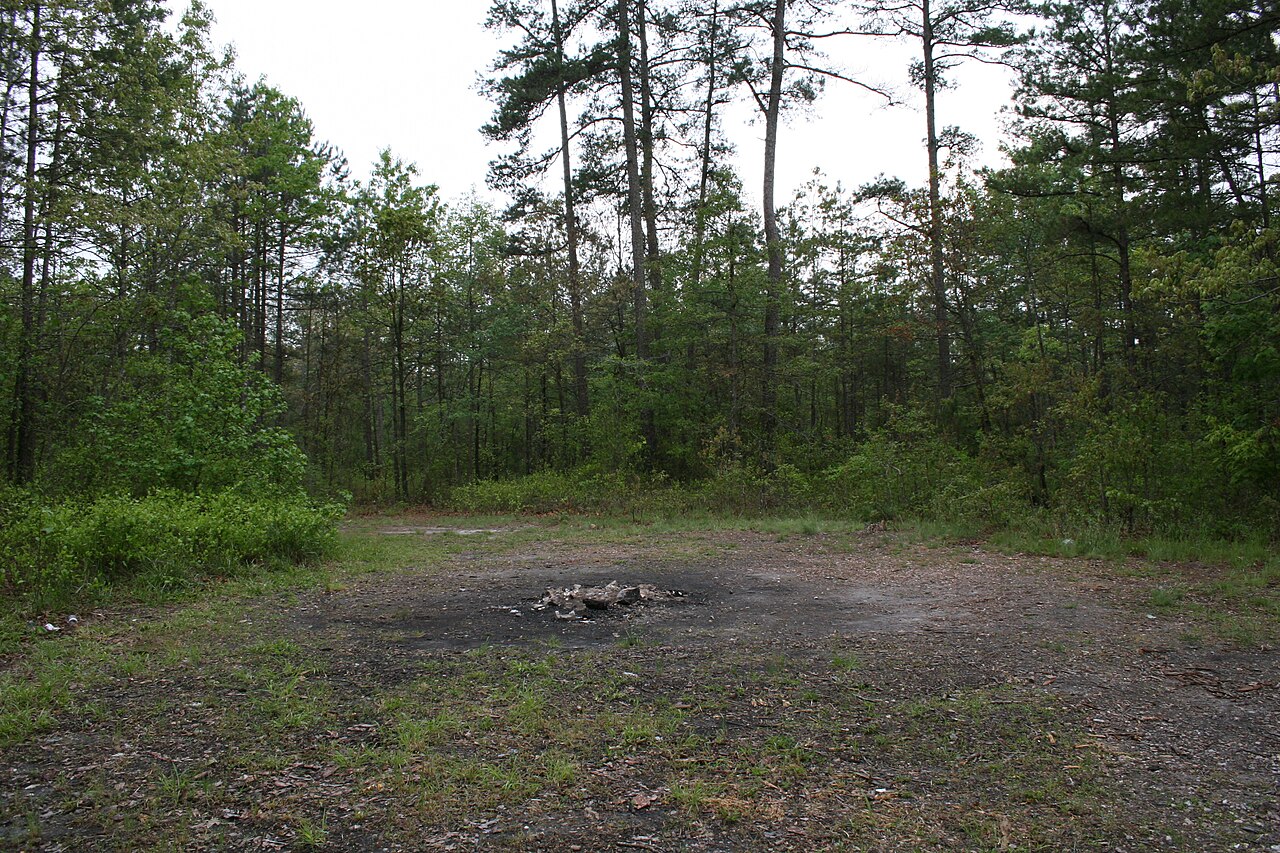
The Devil's Tramping Ground is a camping spot located in a forest near the Harper's Crossroads area in Bear Creek, North Carolina. It has been the subject of persistent local legends and lore, which frequently allege that the Devil "tramps" and haunts a barren circle of ground in which nothing is supposed to grow. It has frequently been noted on lists of unusual place names.
Legends about the ring are well known in local communities. These include the disappearance of objects left within the ring overnight, dogs yipping and howling, not wanting to go near it, and strange events occurring to those who spend the night within its boundaries. It has been alleged that nothing has grown within the 40 feet (12 m) ring for a hundred years. Supposedly it is where the devil walks in circles on certain nights, thinking of ways to bring his evil into this world.
John William Harden (1903–1985) of Greensboro, N.C., journalist, newspaper editor, author, and advisor to North Carolina governors and textile executives, had this to say of the Devil's Tramping Ground:
Chatham natives say... that the Devil goes there to walk in circles as he thinks up new means of causing trouble for humanity. There, sometimes during the dark of night, the Majesty of the Underworld of Evil silently tramps around that bare circle-- thinking, plotting, and planning against good, in behalf of wrong.
The Devil's Tramping Ground is mentioned in two horror novels by Poppy Z. Brite: Lost Souls and Drawing Blood. Both these novels take place, at least in part, in the fictional North Carolina city of Missing Mile; the inspiration for which is taken from Duncan and Chapel Hill, NC and Athens, GA.
Julia Petta
Julia Buccola Petta (1892 – March 17, 1921) was a housewife who became known following her death as The Italian Bride. She was the daughter of Filomena Buccola and the wife of Matthew Petta. She died at the age of 29 in 1921 while giving birth to a stillborn son, Filippo.
Following her death, Petta was buried at Mount Carmel Cemetery in the Chicago, Illinois suburb of Hillside. Petta was buried in her wedding dress. According to legend, soon after Petta's death, her mother Filomena began experiencing dreams in which Petta was telling her that she was still alive. No contemporary source has been found to back up the legend; according to her great grandchildren, Filomena's nightmares may have started about five years later, when the family moved to Los Angeles. Filomena moved back and forth between Chicago and Los Angeles until her death in 1945.
Six years after Petta's death, Filomena secured permission to have the grave opened and her daughter exhumed. The coffin was found to have decomposed somewhat, but when it was opened Petta's body was still mostly intact, her son and the arm holding him had decayed. Her mother took a picture of Petta in her casket, which was placed on the monument and is still there to this day. The exact means by which Filomena secured permission to exhume the body is not known, but it is known that the costs of disinterment and the new monument were paid for, possibly to his own chagrin, by Henry Buccola, Julia's brother. The new monument featured a photo of Petta in her wedding dress and was placed along with a statue of her based on this photo. The photo of Julia after exhumation also appears on the monument.
Some suggest friction existed between Mrs. Buccola and Julia's husband, Matthew, who remarried around the time of the disinterment; it's notable that Julia's married name appears nowhere on the monument, nor that of her stillborn child (though the name of her mother, who is buried nearby, appears twice).
Why Petta's body had not decayed much following burial has never been explained. Some have attributed Petta's condition upon being exhumed to her being incorruptible, while others have attributed the condition of her body to the type of soil found in the cemetery. In 1921 embalming chemicals had already been around for decades, so with a proper embalming and the body placed in an air-sealed coffin the corpse's organs will break down at a very slow pace. Observations of non-decayed bodies that have been deceased for years, even decades, is not uncommon. The exhumations of Abraham Lincoln, Solanus Casey and Eva PerĂ³n are a few of many famous examples of this.
Today Petta is among the more well-known people buried at Mount Carmel, along with prior Bishops and Archbishops of the Archdiocese of Chicago, and organized crime figures such as Al Capone.
Russian Sleep Experiment
The Russian Sleep Experiment is a creepypasta which tells the tale of 5 test subjects being exposed to an experimental sleep-inhibiting stimulant in a Soviet-era scientific experiment, which has become the basis of an urban legend. Many news organizations, including Snopes, News.com.au, and LiveAbout, trace the story's origins to a website, now known as the Creepypasta Wiki, being posted on August 10, 2010, by a user named OrangeSoda, whose real name is unknown.
The story recounts an experiment set in 1947 at a covert Soviet test facility. In a military-sanctioned scientific experiment, five prisoners that were deemed Enemies of the State were kept in a sealed gas chamber, with an experimental gas-based stimulant compound continually administered to keep the subjects awake for 30 consecutive days. The prisoners were falsely promised that they would be set free from the prison if they completed the experiment in the specified 30 days. The subjects behaved as usual during the initial 5 days, talking to each other and whispering to the researchers through the one-way glass, though it was noted that their discussions gradually became darker in the subject matter. After 9 days, one subject began screaming uncontrollably for hours while the others did not react to his outburst. The man screamed for so long that he tore his vocal cords, and was rendered mute as a result. When the second one started screaming, the others prevented the researchers from looking inside by pasting torn book pages and their own feces on the porthole windows. A few days passed without the researchers being able to look inside, during which the chamber was completely silent. The researchers used the intercom to test if the subjects were still alive, and got a short response of a subject expressing compliance.
On the 15th day, the researchers decided to turn off the stimulating gas and reopen the chamber. The subjects did not want the gas to turn off, for fear they would fall asleep. Upon looking inside, they discovered that the four surviving subjects had performed lethal and severe mutilation and disembowelment on themselves during the past days, including tearing off sections of skin and muscles, removing multiple abdominal internal organs, practicing self-cannibalism on themselves, as well as cannibalism of the second subject, and allowing 10 cm (4 inches) of blood and water to accumulate on the floor by jamming paper and pieces of flesh they tore from the second subject into several drains, who was found dead on the floor as soon as the chamber was opened. The subjects violently refused to leave the chamber and begged the scientists to continue administering the stimulant, murdering one soldier and severely injuring another that attempted to remove them. After eventually being removed from the chamber, all subjects were shown to exhibit extreme strength, unprecedented resistance to anaesthetics and sedatives, the ability to remain alive despite lethal injuries, and a desperate desire to stay awake and be given the stimulant. It was also found that if any one of the subjects fell asleep, they would die.
After being somewhat treated for their severe injuries, the surviving three subjects were prepared to return to the gas chamber with the stimulant by the orders of the military officials (though against the will of the researchers), with EEG monitors showing short recurring moments of brain death. Before the chamber was sealed, one of the subjects fell asleep and died, and the only subject that could speak screamed to be immediately sealed in the chamber. The military commander ordered for three other researchers to be closed inside the chamber alongside the two remaining subjects. One researcher immediately drew his gun and killed the commander and the mute subject by shooting both of them in the head, causing the other person to flee the room. With only one surviving subject, the terrified researcher explained that he would not allow himself to be locked in a room with monsters that could no longer be called people. He desperately asked what the subject was, to which the subject smiled and identified himself and the other fallen subjects as an inherent evil inside the human mind that is kept in check by the act of sleeping. After a brief pause, the researcher shot the prisoner in the heart, and with his dying breath on the floor, the subject muttered his final words; "So...nearly...free..."
The Russian Sleep Experiment became immensely popular upon its original publication. It is considered by some to be the greatest and most shared creepypasta story ever made and Dread Central's Josh Millican has called it "one of the most shocking and impactful urban legends of the Internet Age". Much of the online and offline debate surrounds the belief held by many that the story is real rather than fiction, and many articles therefore seek to debunk this claim.
The creepypasta is often shared alongside an image of a grotesque, demonic figure, which is implied to be one of the test subjects. The image is actually of a life-size animatronic Halloween prop called "Spazm".
In the chapter "Horror Memes and Digital Culture" in The Palgrave Handbook of Contemporary Gothic, Tosha R. Taylor wrote that the creepypasta "reflects residual political anxieties as it purports to reveal a top-secret effort by Russian scientists in World War II." Aleksandra Serwotka and Anna Stwora examined "Russian Sleep Experiment" and other creepypasta, stating that most creepypasta that focused on experiments feature scientists who "are frequently somehow related either to Nazi Germany or Soviet Russia".
Sonali Srivastav and Shikha Rai drew comparisons between "Russian Sleep Experiment" and the 2018 miniseries Ghoul, noting that the series took inspiration from the creepypasta.
The Russian Sleep Experiment's popularity has led to various adaptations over the years. A novel inspired by the original short story was published in 2015 but is now out-of-print.
The 2019 play Subject UH1317 - When Science Traces A Deadly Turn is based on the short story.
In early 2018, a psychological thriller based on the short story began production in Ireland, directed by John Farrelly.
In July 2019, horror author Jeremy Bates published The Sleep Experiment, a novel closely based on the original short story.
Several other adaptations have been created, including a film based on the short story entitled The Soviet Sleep Experiment, with Chris Kattan starring and Barry Andersson directing.[15][16] Filming for the movie took place in Lakeville, Minnesota during 2018.[17]
In November 2022, "The Sleep Experiment" by director John Farrelly was released which was based on this incident.
Legend of the Parson and Clerk
The legend of the Parson and Clerk is a story from Devon folklore. The tale revolves around a clergyman, his clerk and their encounter with the Devil, with the setting being near a natural arch located in proximity to the towns of Teignmouth and Dawlish, Devon, England. Along the coast towards Dawlish where the railway runs through the Parson's tunnel can be seen the twin rock stacks of the Parson and his Clerk.
The Parson and Clerk are composed of relatively friable sedimentary Teignmouth Breccia of Permian age, as are all the nearby cliffs. Their soft rock layers are preserved from erosion by the harder "caprock" that was deposited above their strata. A further outer rock, Shag Rock, lost most of its height in a storm in 1984, and then lost its "head" in a storm in January 2003.
The Parson and Clerk and the cliffs are easily viewed from the South West Coast Path which follows the Exeter to Newton Abbot railway line along the coast between Parson's Tunnel and Teignmouth.
Many versions of the story exist. Robert Hunt (in 1881) and Sarah Hewett (1900) relates that a certain Bishop of Exeter fell ill and came to Dawlish to restore his health. However, an ambitious local priest aimed to succeed to the See in the event of his superior's demise.
The priest's guide was his clerk, and they often made the journey to check on the condition of the bishop. One night, in a terrible storm, whilst crossing Haldon moor they lost their way and found themselves miles from the correct path. The priest in his frustration abused his clerk with the words I would rather have the devil himself, than you, for a guide. At that moment a horseman rode by and volunteered to be their guide.
After a few miles they came across a brilliantly lit mansion and were invited by their guide to enter and partake of his hospitality. They enjoyed a sumptuous repast and in the midst of the merriment the news arrived that the bishop was dead. Eager to secure his chance for promotion the priest prepared to leave, together with the clerk and the guide; however the horses refused to move. After liberal use of his whip and spurs the priest cried Devil take the brutes, upon which the guide exclaimed Thank you, sir and shouted Gee up. The horses galloped over the cliff, carrying the parson and the clerk with them. The devil turned them both to stone, facing forever seaward, monuments to greed and disappointed ambition.
A slightly different version of the tale can be found in Legends of Devon, published by Leonard Avat Westcott in 1848. An unidentified elderly and still ambitious clergyman, who had acted as chaplain to a Royal Duke, had a stall at Wells, a prebend at Norwich, and a precentorship in Ireland was promised, by the Archbishop of Canterbury, the next vacant See. The Parson took up residence at a house in East Devon, knowing that the Bishop of Exeter was old and in poor health. On a journey to the Bishop's Palace at Dawlish in a storm the Parson and his clerk (identified as Roger) are disappointed to hear that the Bishop is well and has been hunting deer. They come to a place where the road divides into five lanes and realise they are lost. In Westcott's version it is a footman who comes to their aid offering to guide them to Dawlish after the Parson shouts out, "I wish the Devil, I wish the Devil would put me on the short road to Dawlish".
Despite being unmounted their guide is able to keep-up with the horses. When they reach the Bishop's parlour they hear the Bishop has only a few weeks to live. They are offered a feast of seafood, by a character called the Leech. The seafood is alive, and the other guests at the feast are at first unrecognised by the Parson, and then he realises that they are all deceased clergymen that the Parson once knew. After taking eight grains of opium the Parson and Clerk depart for Teignmouth in a direction suggested by the Leech, who promises them, "Safe lodgings and warm, I warrent ye", if they keep the rocks on their right. Suddenly the Bishop's Palace disappears and they find themselves on the beach, trapped between an incoming tide and the sandstone rocks. At this point in the story they dismount from their horses. The next day the carcases of their mounts are found. The Parson and clerk have disappeared. Two huge pillars of sandstone are found to have appeared on the shoreline though, with one topped with a rock formation resembling a cauliflower wig.
In the version published in "Popular romances of the west of England; or, The drolls, traditions, and superstitions of old Cornwall" the guests at the feast turn into demons. The horses are found alive the next day and the bodies of the Parson and clerk are found clinging to two rocks which have the appearance of horses.
The story appears in 1848 in the anonymously-written Legends of Devon collection. A correspondent to Notes and Queries in 1868 said that all the stories in the collection were original fiction without basis in folklore.
"The legends in question were severally composed by members of a very agreeable little private society, some thirty years ago, of whom I was one. The lady who collected and printed them, and was also one of the contributors, is dead, and so are some of her associates; and to give the names (even if I had permission), would interest few now. But I can say pretty confidently from memory, that they were each and all original whims of the moment, and not reproductions of popular legends.
F C Tottie depicted the Parson & Clerk Rock in an 1847 graphite drawing. The Parson and Clerk was painted by John Wallace Tucker (1808–1869). The painting is held by the Royal Albert Memorial Museum. The Science Museum's Science & Society Picture Library hold two pictures of the Parson and Clerk Rock, one dated 1831, the other dated 1852. The rocks are visible in Murray Secretan's 1935 Great Western Railway centenary poster, almost certainly painted from Parson's Tunnel signal box. The Francis Frith collection hold two photos of the rock formation, both dated 1906.
Niles Canyon Ghost
The Niles Canyon ghost is an urban legend within the vanishing hitchhiker archetype, about the ghost of a girl who had died in a car accident. The accident is said to have taken place on February 28, with the year varying, and the ghost is said to walk the road on that day every year, looking to hitch a ride to San Francisco.
One variation of the story has the hiker's backstory being that she died in a car crash on Niles Canyon road (off the 680 freeway in Sunol, California) on the way back from a dance. Some say that she can be seen at midnight waiting at the corner she died at. People traveling along the road (mostly those traveling alone) have said to have stopped and offered the girl a ride. She accepts the ride, giving the driver an address across the bridge (either Dumbarton or Bay Bridge depending on the storyteller). Once the driver gets to the beginning of the bridge, the girl will disappear. In stories told of the ghost, a driver who visits the girl's address is told by the girl's mother that she died many years previously.
Another version of the story has the ghost described as a White Lady killed in a carriage accident a hundred years previously.
Owlman
In Cornish folklore, the Owlman (Cornish: Cowanden), sometimes referred to as the Cornish Owlman, or the Owlman of Mawnan, is an owl-like humanoid creature said to have been seen in 1976 in the village of Mawnan, Cornwall, UK. The Owlman is sometimes compared to the American Mothman legend from the mid 1960s; however, a Eurasian eagle-owl is likely the source of the legend.
The story originated when Tony "Doc" Shiels claimed to have investigated a report of two young girls on holiday in Mawnan who saw a large winged creature hovering above the tower of St Mawnan and St Stephen's Church, Mawnan on 17 April 1976. According to most versions of the story, the girls, identified as June and Vicky Melling, were so frightened by the sight of a large "feathered bird-man" that their father Don immediately cut short their family holiday after hearing their tale. According to Shiels, one of the girls provided him with a drawing of the creature, which he dubbed "Owlman".
The story was subsequently related in a pamphlet entitled Morgawr: The Monster of Falmouth Bay by Anthony Mawnan-Peller, which circulated throughout Cornwall in 1976. According to Shiels, "Owlman" was reported again on 3 July by two 14-year-old girls identified as Sally Chapman and Barbara Perry, who were aware of the "Owlman" tale. According to the story, the two girls were camping when they were confronted by "a big owl with pointed ears, as big as a man" with glowing eyes and black, pincer-like claws.
Sporadic claims of "Owlman" sightings in the vicinity of the church circulated in 1978, 1979, 1989, and 1995, and according to legend, a "loud, owl-like sound" could be heard at night in the Mullion church yard during the year 2000.
According to author Joe Nickell, church towers are common nesting places for barn owls, which were likely the source of the sightings. Author and Fortean TV presenter Reverend Lionel Fanthorpe also identifies the sighting of a Eurasian eagle-owl as a likely source of the legend.
Occult historian Gareth Medway suggested that the whole thing may have been a hoax by Shiels, who had a reputation for hoaxing. Medway noted that witnesses claiming encounters with a similar legendary monster promoted by Shiels "were either Doc Shiels, or friends of Doc Shiels, or relatives of Doc Shiels, or reported their sightings to Doc Shiels (and to no one else), or else wrote letters describing what they had seen to newspapers and were never interviewed by anyone."
In 2009, the episode "Death Raptor" focused on the Owlman in the Animal Planet TV series Lost Tapes.
"The Owlman Feeds at Midnight" is an episode in Season 1 of the children's TV show The Secret Saturdays. The plot of the episode involves a town terrorised by an Owlman.
The 2012 play 'Horse Piss for Blood' written by Carl Grose, features the Owlman as a key plot point.
The Owlman is depicted in the 2013 Scottish independent horror film Lord of Tears. In this film, The Owlman represents the Semitic god Muloch.
Dudleytown, Connecticut
Dudleytown is an abandoned settlement in northwestern Connecticut in the United States, best known today as a ghost town. Due to vandalism and trespassers, the site is not open to the public.
Since the mid-1920s, the land occupied by the village has been maintained by philanthropists as a private land trust, who worked to reforest the land after decades of agricultural use. Few traces, such as cellar holes, remain of the original village. Due to rumors of ghost activity beginning in the 1980s, the village site has been subject to frequent vandalism, and the owners have since closed the land to the public.
The village was located a few miles south of the Cornwall Bridge neighborhood of Cornwall. It was located in a valley, known as the Dark Entry Forest, due to the shadows caused by the mountains surrounding the village and access road. The town's abandonment has meant that barely any ruins of the original township survive. During the early 20th century, old farms in Cornwall were sold to New Yorkers seeking a better life in the countryside, including Dudleytown, which has been privately owned since 1924 by Dark Entry Forest, Incorporated. The village site is today closed to the public and anyone found trespassing is prosecuted to the fullest extent of the law by the Connecticut State Police and the Department of Energy and Environmental Protection.
In promoting the land trust to investors, a March 1924 prospectus for the Dark Entry Forest stated: "This society is planned to promote forestation, to run a wood mill, to promote conservation of bird, animal and wildflower life, and to afford a playground for you and your children and your children’s children." Soon after acquisition the owners planted thousands of trees. During the 1930s, New York's Skidreiverein Club spent their winter weekends skiing on trails they built in the area; in the summers, they canoed down the Housatonic River. Horse riding camps for children were also held on the site.
A local rumor that has been frequently shared on the internet alleges the founders of Dudleytown were descended from Edmund Dudley, an English nobleman who was beheaded for treason during the reign of Henry VIII. From that moment on, the Dudley family was placed under a curse which followed them across the Atlantic to America. This curse is blamed for instances of crop failures and mental illness, as well as several purported violent deaths in the village. Local historians have found no genealogical link between the Dudley family of Cornwall and the English nobleman and noted many other factual inconsistencies in the rumors. The village's decline has instead been attributed to its distance from clean drinking water and unsuitable soil for cultivation. One confirmed case of suicide of a village resident took place in New York state rather than within Cornwall.
Since the 1990s, police in Cornwall have responded to numerous cases of vandalism. The 1999 movie, The Blair Witch Project, about a haunted forest prompted increased interest in the allegedly haunted village. This increased the frequency of such incidents. The owners of the Dudleytown's property have closed it to the public.
Dover Demon
The Dover Demon is a creature reportedly sighted in the town of Dover, Massachusetts on April 21 and April 22, 1977.
17-year-old William "Bill" Bartlett claimed that while driving on April 21, 1977, he saw a large-eyed creature "with tendril-like fingers" and glowing eyes on top of a broken stone wall on Farm Street in Dover, Massachusetts. 15-year-old John Baxter reported seeing a similar creature on Miller Hill Road the same evening. Another 15-year-old, Abby Brabham, claimed to have seen the creature the following night on Springdale Avenue.
The teenagers all drew sketches of the alleged creature. Bartlett wrote on his sketch, "I, Bill Bartlett, swear on a stack of Bibles that I saw this creature." According to the Boston Globe, "the locations of the sightings, plotted on a map, lay in a straight line over 2 miles".
Some suggested that the creature may have been a foal, newborn elk or a moose calf. Police told the Associated Press that creatures reported by the teenagers "were probably nothing more than a school vacation hoax."
In 2009, The Dover Demon was featured in an episode of the American horror television series Lost Tapes, which aired on Animal Planet.
The Dover Demon appears as a character in the American comic book series Proof, which features various other creatures of cryptozoology. In the comic, it is a creature able to see into the future. It appears in another similar comic book series called The Perhapanauts. The Dover Demon would further make brief appearances in the comic books The Pound: Ghouls Night Out, and Hack/Slash: Entry Wound.
A Dover Demon also appears in the webcomic Gunnerkrigg Court.
Dark Watchers
The Dark Watchers (also known by early Spanish settlers as Los Vigilantes Oscuros) is a name given to a group of entities in California folklore purportedly seen observing travelers along the Santa Lucia Mountains.
The Dark Watchers are described as tall, sometimes giant-sized featureless dark silhouettes often adorned with brimmed hats or walking sticks. They are most often reported to be seen in the hours around twilight and dawn. They are said to motionlessly watch travelers from the horizon along the Santa Lucia Mountain Range. According to legend, no one has seen one up close and if someone were to approach them, they disappear.[
While sometimes attributed to the Chumash people who historically inhabited the central and southern coastal regions of California, nothing analogous to the legend appears to exist in their mythology. When Spanish Settlers first moved into the area they were said to have witnessed the Dark Watchers whom they dubbed Los Vigilantes Oscuros.
The Dark Watchers are most famously given a brief mention in John Steinbeck's "Flight", included in the 1938 collection of his short stories The Long Valley:
"Pepé looked suspiciously back every minute or so, and his eyes sought the tops of the ridges ahead. Once, on a white barren spur, he saw a black figure for a moment; but he looked quickly away, for it was one of the dark watchers. No one knew who the watchers were, nor where they lived, but it was better to ignore them and never to show interest in them. They did not bother one who stayed on the trail and minded his own business."
Along with this, "watchers" are also referenced by poet Robinson Jeffers in the titular poem of his 1937 collection Such Counsels You Gave to Me & Other Poems:
...he thought it might be one of the watchers, who are often seen in this length of coast-range, forms that look human to human eyes, but certainly are not human. They come from behind ridges to watch. But when he approached it he recognized the shabby clothes and pale hair and even the averted forehead and concave line from the eye to the jaw, so that he was not surprised when the figure turning toward him in the quiet twilight showed his own face. Then it melted and merged into the shadows beyond it...
John Steinbeck's son Thomas Steinbeck would grow up to report having seen The Dark Watchers during his childhood and later along with artist Benjamin Brode collaborate on a book titled In Search of the Dark Watchers, where they go into the history of the legend and interview locals who claim to have seen them, such as famed Big Sur resident Billy Post.
According to newspaper archives in the mid-1960s, a Monterery Peninsula local and former high school principal went on a hiking trip in the Santa Lucias when he suddenly spotted a dark figure standing on a rock and surveying the area. When the principal called out to the other hikers, the creature vanished.
Illusions, hallucinations or misinterpretation of natural stimulus brought on by exhaustion or isolation have been proposed by psychologists. Infrasound, which can be generated by wind, can cause feelings of uneasiness and anxiety in some people and is frequently connected to paranormal sightings.
An optical illusion known as the Brocken spectre is a plausible explanation for the legend. A Brocken spectre, "mountain spectre" can occur in certain atmospheric conditions when the sun is at a particular angle. The subject's shadow can be cast onto a cloud bank around them, creating the illusion of a large shadowy humanoid figure.
The Devil's Chair (urban legend)
The term devil's chair (or haunted chair) in folklore is frequently attached to a class of funerary or memorial sculpture common in the United States during the nineteenth century and often associated with legend tripping. Nineteenth-century graveyards sometimes included carved chairs for the comfort of visitors. In this function, the object was known as a "mourning chair," and cemeteries have since provided benches for similar purposes, most often movable units of the type used in parks, but also specimens in the tradition of the carved chairs.
Some carved chairs were probably not intended for use as anything but monuments, while the "monubench" is still commercially available. Once the original purpose of these chairs fell out of fashion, superstitions developed in association with the act of sitting in them. In a typical example, local young people dare one another to visit the site, most often after dark, at midnight, or on some specified night such as Halloween or New Year's Eve. Variously, the stories suggest the person brave enough to sit in the chair at such a time may be punished for impudence or rewarded for courage.
The Haunted Chair of Greenwood Cemetery, Decatur, IL.
The Devil's Chair in Guthrie Center, Iowa, is a cement-cast chair located in Union Cemetery, situated between two graves and unmarked as belonging to either. Local legend claims that bad luck will follow anyone who sits in it. While the cemetery itself was established as a private burial ground in 1885, the legend of the chair is only documented for approximately thirty years.
The Devil's Chair or Baird Chair as it is officially named in the Highland Park Cemetery of Kirksville, Missouri was first placed in the cemetery by Charles Grassle and David Baird when David's wife, Anna Maria (Hoye) Baird, died in 1911. It has become involved in "numerous legends of a type widely replicated across the U.S., especially in rural and small-town communities, and beloved of young people.... Some versions say that something dreadful will happen to the person so bold as to be seated in it at midnight (or on a particular evening, such as Halloween) -- a hand will emerge from the grave and drag the impious one down to the underworld. Other versions suggest the intrepid one will be rewarded." The chair itself was sculpted out of concrete by Charles Grassle of the Baird and Grassle Granite Work of Kirksville MO and placed as a memorial for Anna in 1911. One year later David Baird died and was buried beside Anna. This chair acts as their grave marker.
Oakwood Cemetery in Syracuse, NY contains a child-sized specimen.
The Duncan monument in the Fletcher Cemetery, Fletcher, OH appears to be a carved headstone rather than a mourning chair intended for use by cemetery visitors.
"The Empty Chair" in Hope Cemetery, Barre, VT is actually a sculpted gravestone rather than being intended as a seat. However, the usual legends have grown up around it.
In Bonaventure Cemetery located in Savannah, Georgia the grave of famed music writer Johnny Mercer is formed in the style of one of these seats. Interestingly, contrary to other similar markers, Mercer's marker has writings and quotes on it and serves more as the tombstone, than a mourning chair.
Black Volga
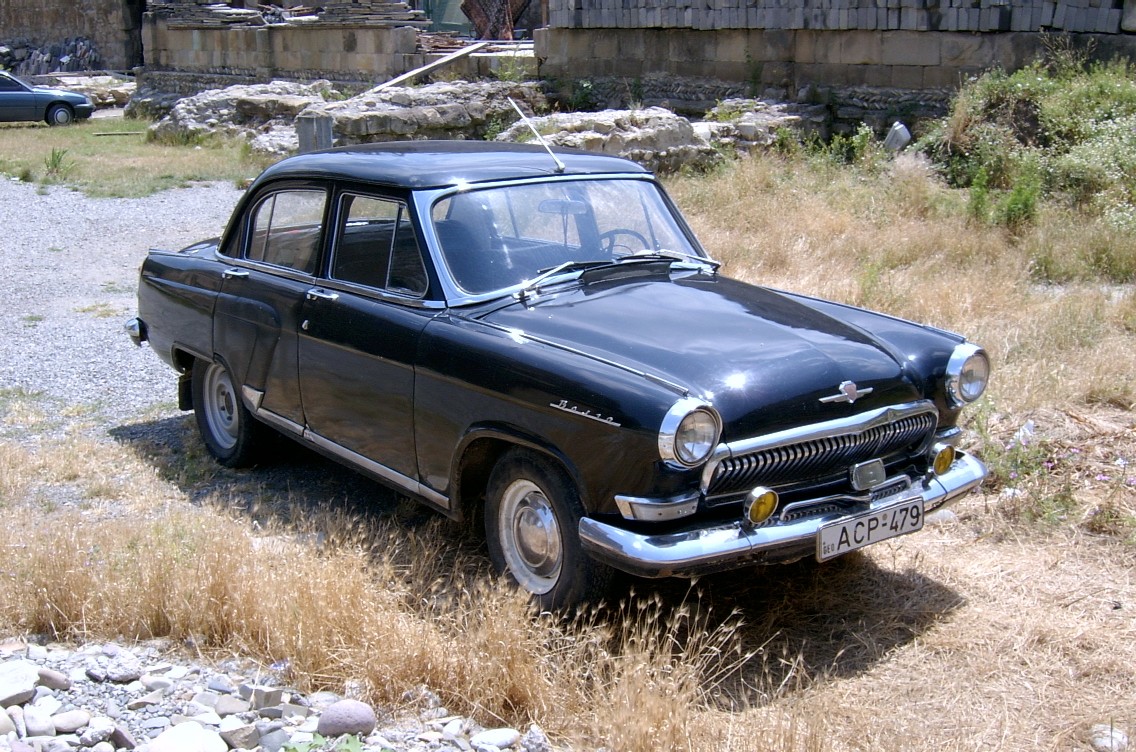
Black Volga (Polish: czarna wołga) refers to an urban legend widespread in Poland, Romania, Hungary, Russia, Belarus, Ukraine, Greece and Mongolia, mainly in the 1960s and 1970s. The legend refers to a black (or in some versions red) GAZ-21 or GAZ-24 that was allegedly used to abduct and murder people. According to different versions, it was driven by communist secret police, Russian mafia, Satanists or Satan himself. The car is described as having white wheel rims, white curtains or other white elements.
A black GAZ-M1
This impression was also caused by the active use of the passenger car of the Gorky Automobile Plant GAZ-M1 (Emka) by the NKVD bodies during the years of mass repression. For the sake of saving money, during almost all the time of its release, the M1 was only available with black paint, which emphasized the ominous image of the car.
Supposedly, victims were kidnapped and then murdered by the perpetrators to use their blood as a cure for rich Westerners or Arabs suffering from leukemia. Other variants used organ theft as the motive, combing it with another infamous legend of kidney theft by the KGB. The legend surfaced again in the late 20th century, with a BMW or Mercedes car taking the Volga's place. The Black Volga was sometimes depicted with horns instead of wing mirrors. It could also have the number "666" on the license plate, as well as having white windows or curtains. In this version, the driver (allegedly the devil) would ask passers-by for the time and kill them when they approached the car to answer. In another version of the legend, the victim would die at the same time a day later (the driver would say: "Tomorrow you will die at this hour"). However, there was an effective defence method—whenever the driver of the Black Volga asked "What time is it?", the person would have to answer "It is God's time". Then the car would quickly vanish.
In Czechoslovakia, the story appeared in the late 1970s as the black ambulance, while in Romania, the Volgas were replaced in the 1970s with Dacia 1301s, a modified version of the Dacia 1300 with several features not available to the public, which were eventually replaced by ambulances as well in the 1990s.
Beast of Exmoor
In British folklore, the Beast of Exmoor, also known as the Exmoor Beast, is a phantom cat said to roam the fields of Exmoor in Devon and Somerset in the United Kingdom.
There have been numerous reports of eyewitness sightings; however, the official Exmoor National Park website lists the beast under "Traditions, Folklore, and Legends", and the BBC calls it "the famous-yet-elusive beast of Exmoor." Sightings were first reported in the 1970s, although it became notorious in 1983, when a South Molton farmer named Eric Ley claimed to have lost over 100 sheep in the space of three months, all of them apparently killed by violent throat injuries. There was even a report of the Beast seen "fishing" with its paw into the River Barle at Simonsbath, whilst some locals theorised that its lair might be in old mine workings on the Moor. The Daily Express offered a reward for the capture or slaying of the Beast. Farm animal deaths in the area have been sporadically blamed on the Beast ever since. Sightings were reported in the Devon and Somerset areas of England.
It has been suggested that the beast may possibly be a cougar or black leopard which was released from a private collection sometime in the 1960s or 1970s after a law was passed making it illegal for them to be kept in captivity outside zoos. However, considering that cougar and leopard life spans are 12–15 years, this is unlikely. In 2006 the British Big Cats Society reported that a skull found by a Devon farmer was that of a puma, however the Department for Environment, Food and Rural Affairs (DEFRA) states that "Based on the evidence, DEFRA does not believe that there are big cats living in the wild in England."
Eyewitness testimony has produced a number of different descriptions. Most accounts report the animal as being a large cat either resembling a puma or a panther. It is recorded as being somewhere between three and four feet six inches long from nose to tail and 2 feet six inches in shoulder height, standing very low to the ground, and as having the ability to leap over 6-foot-tall fences with ease. Descriptions of its coloration range from black to tan or dark grey, with white markings on its head and neck. It is described as having a squat head with a short neck, a muscular body, and short legs. Its pawprints are three to four inches across. It is described as nocturnal.
No such cat is native to England, and the variations in description have led some cryptozoologists to believe that there might be more than one creature.
Photographs have been produced on at least three occasions, one of which appeared in the West Somerset Free Press in 1989, taken by the Lewis Family of Blue Anchor, and all appear to show a big cat with the features of both a puma and a panther..
Most observers and scientists believe that the sightings are merely of escaped domestic cats whose size has been greatly exaggerated, or else of large dogs that have been misidentified. The livestock deaths have often been attributed to these large dogs, although human attacks on the sheep have also been suspected.
Although large cats are not native to England, some people have kept exotic animals, and in the mid 1970s this became something of a fad. It is inevitable that some have escaped over the years, and conceivable that they created a small group of big cats living hidden in the Exmoor area's countryside. In particular, the 1976 Dangerous Wild Animals Act, which controlled the keeping of big cats (among other things) led to the mass release of many privately owned wild cats.
According to the Exmoor zoo, "The Exmoor Beast is understood to be a melanistic leopard. These are a genetic mutation that exists in the wild." Some descriptions of the Beast attribute it the features of both a puma and a leopard. Although these animals have been hybridized by Carl Hagenbeck in captivity, the offspring were always found to be dwarfed and short-lived; one such hybrid is preserved in the Zoological Museum at Tring. The name for such a hybrid is a Pumapard. Because male big cat hybrids are always sterile, a self-perpetuating race of puma-leopard hybrids is not possible.
In 1983, in response to increased reports of livestock death and sightings of the Beast, the Royal Marines staked out the Exmoor hills. Although some Marines claimed to have seen the Beast through night-vision equipment, no shots were fired, partially because of the risk of the Marines' high-powered sniper rifle bullets passing straight through the creature's body and then causing injury to humans or livestock etc., and the number of attacks on livestock dwindled.
During the search the Marines' commanding officer was quoted as saying that their quarry behaved with high, almost human, intelligence and "always moved with surrounding cover amongst hedges and woods". Ultimately, the Marines were recalled from the field, due to concerns they might mistakenly shoot one of several reward-seeking amateur photographers thought to be on the same hunt.
By 1987, the creature was connected to over 200 farm animal deaths. More recent attacks were reported in 1995 and 2001. The Ministry continued to study the reported sightings into the mid-1990s, before concluding that the Beast was either a hoax or myth and that the alleged sightings had been mistaken identifications of creatures native to the Exmoor area.
The babysitter and the man upstairs
The babysitter and the man upstairs — also known as the babysitter or the sitter — is an urban legend that dates back to the 1960s about a teenage girl babysitting children who receives telephone calls from a stalker who continually asks her to "check the children". The basic story line has been adapted a number of times in movies. The 1950 murder of teenage babysitter Janett Christman is commonly cited as a source of the legend.
The legend details a teenage girl who is watching television at night while babysitting after the children have been put to bed upstairs. The phone rings; the unknown caller tells her, "Check the children." The girl dismisses the call, but the anonymous caller dials back several times, and the girl becomes increasingly frightened. Eventually, the babysitter calls the police, who inform her they will trace the next call. After the stranger calls again, the police return her call, advising her to leave immediately. She evacuates the home and the police meet her to explain that the calls were coming from inside the house and that the unidentified prowler was calling her after killing the children upstairs.
Some variants of the story have one or more of these details:
In more modern versions, rather than be tormented by menacing phone calls, the babysitter is unnerved by what she assumes to be a hideous, life-sized statue of a clown in the corner of the room. When the mother or father of the children she is caring for calls home to check in, the babysitter asks if she can cover the clown statue with a blanket. The parent informs the babysitter they do not own a clown statue: the "statue" was really a murderer, who attacks and kills the girl before she can escape.
In more child-friendly versions, the caller turns out to be either one of the children or an elder sibling who decided to scare the babysitter as a prank and they get told off by the police.
The babysitter is also killed.
The babysitter manages to rescue the children and the prowler gets arrested by the police; however, in most versions the children do not survive.
While being taken away by the police, the prowler whispers or says out loud "See you soon!" to the babysitter.
In some versions, when the prowler calls the babysitter, he just makes scary noises like giggling or heavy breathing.[4] Also in this version, when the operator says that the calls have been coming from the same house, the phone goes quiet, and when the operator asks if the babysitter is still there, all they get is the same scary noises, meaning that the babysitter has already been killed.
The children are with the babysitter while watching television. The prowler starts phoning them, saying that he'll be with them in a decreasing amount of time. Then after they get the news that the calls are coming from inside the house, they hear a door upstairs opening and then the sound of footsteps heading towards the room where they are. This version can be found in the Scary Stories to Tell in the Dark books.
Years later, the babysitter is now an adult and has a family of her own. One evening, she and her husband go to have dinner out while a babysitter looks after the children. The evening is going well until a waiter approaches their table and says that there is a phone call for her. She then answers the phone and hears "Did you check the children?". This is an ending that appears in some of the movie versions.
The police inform one of the children that they found the prowler under the kid's bed holding a weapon.
Baby Train
The Baby Train, or simply Baby Train, is an urban legend told in the United States, United Kingdom and Australia. The legend first appeared in Christopher Morley's 1939 novel Kitty Foyle. According to the legend, a certain small town had an unusually high birth rate. This was allegedly caused by a freight train passing through the town and blowing its whistle, waking up all the residents. Since it was too late to go back to sleep and too early to get up, couples would have sex. This resulted in a mini-baby boom.
One version of the myth, as written down by the Australian author and folklorist Bill Scott in The Long & The Short & The Tall: a collection of Australian yarns tells the story of a little town on the coast, not too far north of Sydney, where the birth rate was three times the average for all the rest of Australia. This was so unusual the Government sent someone out to the town to investigate the cause for the high birth rate.
When the official arrived, he found children everywhere he looked. "Even the local school had those temporary classrooms all over the place to fit them in and they had a special maternity wing at the local hospital." The man was mystified for a while. The people there did not seem different from people in other small towns, so he couldn't understand why they got three times as many children. After a few nights in the town, the man figured it out.
This particular town was right by the main railway line. The train was delivering mail right past the town, and thus blew its whistle when it stopped. Since it was too early to get up and it was too late to go back to sleep again, the adults had to find something to do in bed while waiting. This then led to the very high birth rates.
Other versions of the myth vary to different degrees. Sometimes the small town is in America or England, and one version tells of noisy foghorns rather a than train whistle.
The story is related to the rumour that birth rates spiked nine months after the Northeast Blackout of 1965, the actual birthrate increase in Boston after February 1969 nor'easter September 11, 2001 terrorist attacks, and other natural disasters and similar events. It is based on the premise that when regular life is disrupted adults will resort to sex as occupation without regard for family planning or protection.
In 1939 Baby Train was mentioned in Christopher Morley's novel Kitty Foyle: "The first thing you hear mornings in Manitou is the early Q train to Chicago. It's too early to get up and too late to go to sleep again. They have a legend out there that the morning yells of that rattler do a good deal to keep up the birth-rate."
In 1944 the story was published in The New Anecdota Americana: Five Hundred Stories for America's Amusement.
In 1946 it appeared in A Collection of Jokes and Anecdotes by Bennett Cerf: "A visitor to "a small town near Charleston" is struck by the number of children in that village and thinks to ask the waiter at his hotel about it. The obliging server takes the traveler to see the train tracks at the east end of town where the expresses to Miami come barreling through. "It's this way," he explained. "That damned train rushes by here every morning at seven o'clock. It's too early to get out of bed, and too late to go back to sleep.""
In 1946 Frank Cunningham wrote the book Big Dan: The Story Of A Colorful Railroader about the railroader Daniel Goode Cunningham or Big Dan. In the book the Baby Train myth is mentioned.
In 1956 Baby Train popped up in Playboy's "Party Jokes".
In 1967 Reader's Digest mentioned a version of the myth without a train: "A harried young serviceman, tripping over small children, babies in buggies and the assorted paraphernalia of the very young in a shopping area of San Francisco, sputtered exasperatedly, "Good Lord! Don't these people around here ever do anything else?" A passerby commented knowingly, "It's the foghorns.""
In 1985 Bill Scott, an Australian folklorist published The Long & The Short & The Tall: a collection of Australian yarns, where the Baby Train is written down.
In 1993 folklorist Jan Harold Brunvand published the book The Baby Train & Other Lusty Urban Legends. The Baby Train was Brunvand's fifth in a series of books that set out to document, and occasionally debunk, urban legends such as "Cactus and Spiders," "The Slasher Under the Car," and "Car Theft during Earth Quake," along with the "Baby Train." Many of the stories were collected from readers of Brunvand's syndicated newspaper column, "Urban Legend". Like Brunvand's previous urban legend books, stories in The Baby Train & Other Lusty Urban Legends are divided into common themes: automobiles, animals, horror, accidents, sex and scandals, crime, business and professional, government, celebrity rumours, and academic legends.
Subscribe to:
Posts (Atom)