What's On

Showing posts with label Urban Legend. Show all posts

Saturday, January 14, 2023

Devil's Tramping Ground

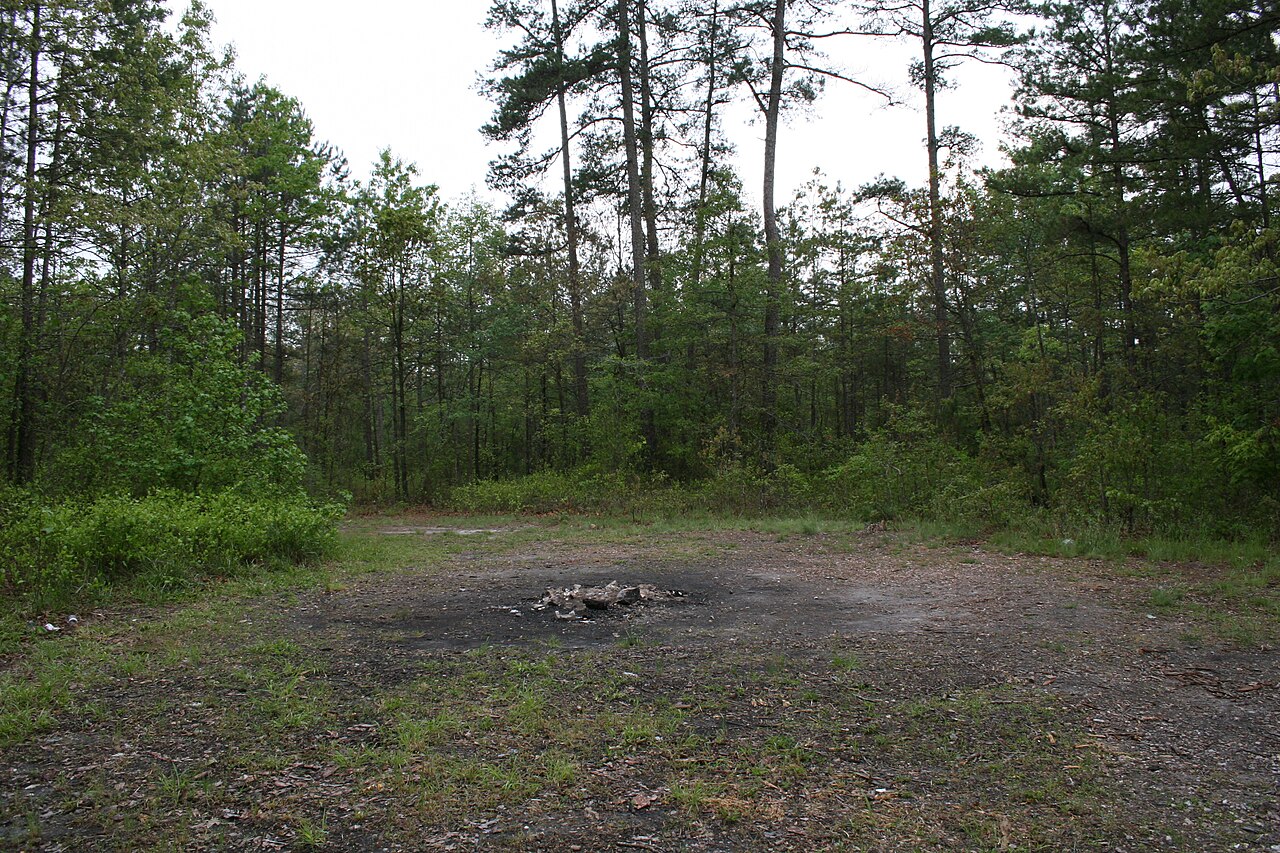
The Devil's Tramping Ground is a camping spot located in a forest near the Harper's Crossroads area in Bear Creek, North Carolina. It has been the subject of persistent local legends and lore, which frequently allege that the Devil "tramps" and haunts a barren circle of ground in which nothing is supposed to grow. It has frequently been noted on lists of unusual place names.
Legends about the ring are well known in local communities. These include the disappearance of objects left within the ring overnight, dogs yipping and howling, not wanting to go near it, and strange events occurring to those who spend the night within its boundaries. It has been alleged that nothing has grown within the 40 feet (12 m) ring for a hundred years. Supposedly it is where the devil walks in circles on certain nights, thinking of ways to bring his evil into this world. John William Harden (1903–1985) of Greensboro, N.C., journalist, newspaper editor, author, and advisor to North Carolina governors and textile executives, had this to say of the Devil's Tramping Ground: Chatham natives say... that the Devil goes there to walk in circles as he thinks up new means of causing trouble for humanity. There, sometimes during the dark of night, the Majesty of the Underworld of Evil silently tramps around that bare circle-- thinking, plotting, and planning against good, in behalf of wrong.
The Devil's Tramping Ground is mentioned in two horror novels by Poppy Z. Brite: Lost Souls and Drawing Blood. Both these novels take place, at least in part, in the fictional North Carolina city of Missing Mile; the inspiration for which is taken from Duncan and Chapel Hill, NC and Athens, GA.

Julia Petta

Julia Buccola Petta (1892 – March 17, 1921) was a housewife who became known following her death as The Italian Bride. She was the daughter of Filomena Buccola and the wife of Matthew Petta. She died at the age of 29 in 1921 while giving birth to a stillborn son, Filippo.
Following her death, Petta was buried at Mount Carmel Cemetery in the Chicago, Illinois suburb of Hillside. Petta was buried in her wedding dress. According to legend, soon after Petta's death, her mother Filomena began experiencing dreams in which Petta was telling her that she was still alive. No contemporary source has been found to back up the legend; according to her great grandchildren, Filomena's nightmares may have started about five years later, when the family moved to Los Angeles. Filomena moved back and forth between Chicago and Los Angeles until her death in 1945. Six years after Petta's death, Filomena secured permission to have the grave opened and her daughter exhumed. The coffin was found to have decomposed somewhat, but when it was opened Petta's body was still mostly intact, her son and the arm holding him had decayed. Her mother took a picture of Petta in her casket, which was placed on the monument and is still there to this day. The exact means by which Filomena secured permission to exhume the body is not known, but it is known that the costs of disinterment and the new monument were paid for, possibly to his own chagrin, by Henry Buccola, Julia's brother. The new monument featured a photo of Petta in her wedding dress and was placed along with a statue of her based on this photo. The photo of Julia after exhumation also appears on the monument. Some suggest friction existed between Mrs. Buccola and Julia's husband, Matthew, who remarried around the time of the disinterment; it's notable that Julia's married name appears nowhere on the monument, nor that of her stillborn child (though the name of her mother, who is buried nearby, appears twice). Why Petta's body had not decayed much following burial has never been explained. Some have attributed Petta's condition upon being exhumed to her being incorruptible, while others have attributed the condition of her body to the type of soil found in the cemetery. In 1921 embalming chemicals had already been around for decades, so with a proper embalming and the body placed in an air-sealed coffin the corpse's organs will break down at a very slow pace. Observations of non-decayed bodies that have been deceased for years, even decades, is not uncommon. The exhumations of Abraham Lincoln, Solanus Casey and Eva PerĂ³n are a few of many famous examples of this. Today Petta is among the more well-known people buried at Mount Carmel, along with prior Bishops and Archbishops of the Archdiocese of Chicago, and organized crime figures such as Al Capone.

Russian Sleep Experiment

The Russian Sleep Experiment is a creepypasta which tells the tale of 5 test subjects being exposed to an experimental sleep-inhibiting stimulant in a Soviet-era scientific experiment, which has become the basis of an urban legend. Many news organizations, including Snopes, News.com.au, and LiveAbout, trace the story's origins to a website, now known as the Creepypasta Wiki, being posted on August 10, 2010, by a user named OrangeSoda, whose real name is unknown.
The story recounts an experiment set in 1947 at a covert Soviet test facility. In a military-sanctioned scientific experiment, five prisoners that were deemed Enemies of the State were kept in a sealed gas chamber, with an experimental gas-based stimulant compound continually administered to keep the subjects awake for 30 consecutive days. The prisoners were falsely promised that they would be set free from the prison if they completed the experiment in the specified 30 days. The subjects behaved as usual during the initial 5 days, talking to each other and whispering to the researchers through the one-way glass, though it was noted that their discussions gradually became darker in the subject matter. After 9 days, one subject began screaming uncontrollably for hours while the others did not react to his outburst. The man screamed for so long that he tore his vocal cords, and was rendered mute as a result. When the second one started screaming, the others prevented the researchers from looking inside by pasting torn book pages and their own feces on the porthole windows. A few days passed without the researchers being able to look inside, during which the chamber was completely silent. The researchers used the intercom to test if the subjects were still alive, and got a short response of a subject expressing compliance. On the 15th day, the researchers decided to turn off the stimulating gas and reopen the chamber. The subjects did not want the gas to turn off, for fear they would fall asleep. Upon looking inside, they discovered that the four surviving subjects had performed lethal and severe mutilation and disembowelment on themselves during the past days, including tearing off sections of skin and muscles, removing multiple abdominal internal organs, practicing self-cannibalism on themselves, as well as cannibalism of the second subject, and allowing 10 cm (4 inches) of blood and water to accumulate on the floor by jamming paper and pieces of flesh they tore from the second subject into several drains, who was found dead on the floor as soon as the chamber was opened. The subjects violently refused to leave the chamber and begged the scientists to continue administering the stimulant, murdering one soldier and severely injuring another that attempted to remove them. After eventually being removed from the chamber, all subjects were shown to exhibit extreme strength, unprecedented resistance to anaesthetics and sedatives, the ability to remain alive despite lethal injuries, and a desperate desire to stay awake and be given the stimulant. It was also found that if any one of the subjects fell asleep, they would die. After being somewhat treated for their severe injuries, the surviving three subjects were prepared to return to the gas chamber with the stimulant by the orders of the military officials (though against the will of the researchers), with EEG monitors showing short recurring moments of brain death. Before the chamber was sealed, one of the subjects fell asleep and died, and the only subject that could speak screamed to be immediately sealed in the chamber. The military commander ordered for three other researchers to be closed inside the chamber alongside the two remaining subjects. One researcher immediately drew his gun and killed the commander and the mute subject by shooting both of them in the head, causing the other person to flee the room. With only one surviving subject, the terrified researcher explained that he would not allow himself to be locked in a room with monsters that could no longer be called people. He desperately asked what the subject was, to which the subject smiled and identified himself and the other fallen subjects as an inherent evil inside the human mind that is kept in check by the act of sleeping. After a brief pause, the researcher shot the prisoner in the heart, and with his dying breath on the floor, the subject muttered his final words; "So...nearly...free..."
The Russian Sleep Experiment became immensely popular upon its original publication. It is considered by some to be the greatest and most shared creepypasta story ever made and Dread Central's Josh Millican has called it "one of the most shocking and impactful urban legends of the Internet Age". Much of the online and offline debate surrounds the belief held by many that the story is real rather than fiction, and many articles therefore seek to debunk this claim. The creepypasta is often shared alongside an image of a grotesque, demonic figure, which is implied to be one of the test subjects. The image is actually of a life-size animatronic Halloween prop called "Spazm".
In the chapter "Horror Memes and Digital Culture" in The Palgrave Handbook of Contemporary Gothic, Tosha R. Taylor wrote that the creepypasta "reflects residual political anxieties as it purports to reveal a top-secret effort by Russian scientists in World War II." Aleksandra Serwotka and Anna Stwora examined "Russian Sleep Experiment" and other creepypasta, stating that most creepypasta that focused on experiments feature scientists who "are frequently somehow related either to Nazi Germany or Soviet Russia". Sonali Srivastav and Shikha Rai drew comparisons between "Russian Sleep Experiment" and the 2018 miniseries Ghoul, noting that the series took inspiration from the creepypasta. The Russian Sleep Experiment's popularity has led to various adaptations over the years. A novel inspired by the original short story was published in 2015 but is now out-of-print. The 2019 play Subject UH1317 - When Science Traces A Deadly Turn is based on the short story. In early 2018, a psychological thriller based on the short story began production in Ireland, directed by John Farrelly. In July 2019, horror author Jeremy Bates published The Sleep Experiment, a novel closely based on the original short story. Several other adaptations have been created, including a film based on the short story entitled The Soviet Sleep Experiment, with Chris Kattan starring and Barry Andersson directing.[15][16] Filming for the movie took place in Lakeville, Minnesota during 2018.[17] In November 2022, "The Sleep Experiment" by director John Farrelly was released which was based on this incident.
Legend of the Parson and Clerk

The legend of the Parson and Clerk is a story from Devon folklore. The tale revolves around a clergyman, his clerk and their encounter with the Devil, with the setting being near a natural arch located in proximity to the towns of Teignmouth and Dawlish, Devon, England. Along the coast towards Dawlish where the railway runs through the Parson's tunnel can be seen the twin rock stacks of the Parson and his Clerk.
The Parson and Clerk are composed of relatively friable sedimentary Teignmouth Breccia of Permian age, as are all the nearby cliffs. Their soft rock layers are preserved from erosion by the harder "caprock" that was deposited above their strata. A further outer rock, Shag Rock, lost most of its height in a storm in 1984, and then lost its "head" in a storm in January 2003. The Parson and Clerk and the cliffs are easily viewed from the South West Coast Path which follows the Exeter to Newton Abbot railway line along the coast between Parson's Tunnel and Teignmouth.
Many versions of the story exist. Robert Hunt (in 1881) and Sarah Hewett (1900) relates that a certain Bishop of Exeter fell ill and came to Dawlish to restore his health. However, an ambitious local priest aimed to succeed to the See in the event of his superior's demise. The priest's guide was his clerk, and they often made the journey to check on the condition of the bishop. One night, in a terrible storm, whilst crossing Haldon moor they lost their way and found themselves miles from the correct path. The priest in his frustration abused his clerk with the words I would rather have the devil himself, than you, for a guide. At that moment a horseman rode by and volunteered to be their guide. After a few miles they came across a brilliantly lit mansion and were invited by their guide to enter and partake of his hospitality. They enjoyed a sumptuous repast and in the midst of the merriment the news arrived that the bishop was dead. Eager to secure his chance for promotion the priest prepared to leave, together with the clerk and the guide; however the horses refused to move. After liberal use of his whip and spurs the priest cried Devil take the brutes, upon which the guide exclaimed Thank you, sir and shouted Gee up. The horses galloped over the cliff, carrying the parson and the clerk with them. The devil turned them both to stone, facing forever seaward, monuments to greed and disappointed ambition. A slightly different version of the tale can be found in Legends of Devon, published by Leonard Avat Westcott in 1848. An unidentified elderly and still ambitious clergyman, who had acted as chaplain to a Royal Duke, had a stall at Wells, a prebend at Norwich, and a precentorship in Ireland was promised, by the Archbishop of Canterbury, the next vacant See. The Parson took up residence at a house in East Devon, knowing that the Bishop of Exeter was old and in poor health. On a journey to the Bishop's Palace at Dawlish in a storm the Parson and his clerk (identified as Roger) are disappointed to hear that the Bishop is well and has been hunting deer. They come to a place where the road divides into five lanes and realise they are lost. In Westcott's version it is a footman who comes to their aid offering to guide them to Dawlish after the Parson shouts out, "I wish the Devil, I wish the Devil would put me on the short road to Dawlish". Despite being unmounted their guide is able to keep-up with the horses. When they reach the Bishop's parlour they hear the Bishop has only a few weeks to live. They are offered a feast of seafood, by a character called the Leech. The seafood is alive, and the other guests at the feast are at first unrecognised by the Parson, and then he realises that they are all deceased clergymen that the Parson once knew. After taking eight grains of opium the Parson and Clerk depart for Teignmouth in a direction suggested by the Leech, who promises them, "Safe lodgings and warm, I warrent ye", if they keep the rocks on their right. Suddenly the Bishop's Palace disappears and they find themselves on the beach, trapped between an incoming tide and the sandstone rocks. At this point in the story they dismount from their horses. The next day the carcases of their mounts are found. The Parson and clerk have disappeared. Two huge pillars of sandstone are found to have appeared on the shoreline though, with one topped with a rock formation resembling a cauliflower wig. In the version published in "Popular romances of the west of England; or, The drolls, traditions, and superstitions of old Cornwall" the guests at the feast turn into demons. The horses are found alive the next day and the bodies of the Parson and clerk are found clinging to two rocks which have the appearance of horses.
The story appears in 1848 in the anonymously-written Legends of Devon collection. A correspondent to Notes and Queries in 1868 said that all the stories in the collection were original fiction without basis in folklore. "The legends in question were severally composed by members of a very agreeable little private society, some thirty years ago, of whom I was one. The lady who collected and printed them, and was also one of the contributors, is dead, and so are some of her associates; and to give the names (even if I had permission), would interest few now. But I can say pretty confidently from memory, that they were each and all original whims of the moment, and not reproductions of popular legends. F C Tottie depicted the Parson & Clerk Rock in an 1847 graphite drawing. The Parson and Clerk was painted by John Wallace Tucker (1808–1869). The painting is held by the Royal Albert Memorial Museum. The Science Museum's Science & Society Picture Library hold two pictures of the Parson and Clerk Rock, one dated 1831, the other dated 1852. The rocks are visible in Murray Secretan's 1935 Great Western Railway centenary poster, almost certainly painted from Parson's Tunnel signal box. The Francis Frith collection hold two photos of the rock formation, both dated 1906.

Niles Canyon Ghost

The Niles Canyon ghost is an urban legend within the vanishing hitchhiker archetype, about the ghost of a girl who had died in a car accident. The accident is said to have taken place on February 28, with the year varying, and the ghost is said to walk the road on that day every year, looking to hitch a ride to San Francisco. One variation of the story has the hiker's backstory being that she died in a car crash on Niles Canyon road (off the 680 freeway in Sunol, California) on the way back from a dance. Some say that she can be seen at midnight waiting at the corner she died at. People traveling along the road (mostly those traveling alone) have said to have stopped and offered the girl a ride. She accepts the ride, giving the driver an address across the bridge (either Dumbarton or Bay Bridge depending on the storyteller). Once the driver gets to the beginning of the bridge, the girl will disappear. In stories told of the ghost, a driver who visits the girl's address is told by the girl's mother that she died many years previously. Another version of the story has the ghost described as a White Lady killed in a carriage accident a hundred years previously.

Dark Watchers

The Dark Watchers (also known by early Spanish settlers as Los Vigilantes Oscuros) is a name given to a group of entities in California folklore purportedly seen observing travelers along the Santa Lucia Mountains. The Dark Watchers are described as tall, sometimes giant-sized featureless dark silhouettes often adorned with brimmed hats or walking sticks. They are most often reported to be seen in the hours around twilight and dawn. They are said to motionlessly watch travelers from the horizon along the Santa Lucia Mountain Range. According to legend, no one has seen one up close and if someone were to approach them, they disappear.[
While sometimes attributed to the Chumash people who historically inhabited the central and southern coastal regions of California, nothing analogous to the legend appears to exist in their mythology. When Spanish Settlers first moved into the area they were said to have witnessed the Dark Watchers whom they dubbed Los Vigilantes Oscuros. The Dark Watchers are most famously given a brief mention in John Steinbeck's "Flight", included in the 1938 collection of his short stories The Long Valley: "Pepé looked suspiciously back every minute or so, and his eyes sought the tops of the ridges ahead. Once, on a white barren spur, he saw a black figure for a moment; but he looked quickly away, for it was one of the dark watchers. No one knew who the watchers were, nor where they lived, but it was better to ignore them and never to show interest in them. They did not bother one who stayed on the trail and minded his own business." Along with this, "watchers" are also referenced by poet Robinson Jeffers in the titular poem of his 1937 collection Such Counsels You Gave to Me & Other Poems: ...he thought it might be one of the watchers, who are often seen in this length of coast-range, forms that look human to human eyes, but certainly are not human. They come from behind ridges to watch. But when he approached it he recognized the shabby clothes and pale hair and even the averted forehead and concave line from the eye to the jaw, so that he was not surprised when the figure turning toward him in the quiet twilight showed his own face. Then it melted and merged into the shadows beyond it... John Steinbeck's son Thomas Steinbeck would grow up to report having seen The Dark Watchers during his childhood and later along with artist Benjamin Brode collaborate on a book titled In Search of the Dark Watchers, where they go into the history of the legend and interview locals who claim to have seen them, such as famed Big Sur resident Billy Post. According to newspaper archives in the mid-1960s, a Monterery Peninsula local and former high school principal went on a hiking trip in the Santa Lucias when he suddenly spotted a dark figure standing on a rock and surveying the area. When the principal called out to the other hikers, the creature vanished.
Illusions, hallucinations or misinterpretation of natural stimulus brought on by exhaustion or isolation have been proposed by psychologists. Infrasound, which can be generated by wind, can cause feelings of uneasiness and anxiety in some people and is frequently connected to paranormal sightings. An optical illusion known as the Brocken spectre is a plausible explanation for the legend. A Brocken spectre, "mountain spectre" can occur in certain atmospheric conditions when the sun is at a particular angle. The subject's shadow can be cast onto a cloud bank around them, creating the illusion of a large shadowy humanoid figure.

The Devil's Chair (urban legend)

The term devil's chair (or haunted chair) in folklore is frequently attached to a class of funerary or memorial sculpture common in the United States during the nineteenth century and often associated with legend tripping. Nineteenth-century graveyards sometimes included carved chairs for the comfort of visitors. In this function, the object was known as a "mourning chair," and cemeteries have since provided benches for similar purposes, most often movable units of the type used in parks, but also specimens in the tradition of the carved chairs. Some carved chairs were probably not intended for use as anything but monuments, while the "monubench" is still commercially available. Once the original purpose of these chairs fell out of fashion, superstitions developed in association with the act of sitting in them. In a typical example, local young people dare one another to visit the site, most often after dark, at midnight, or on some specified night such as Halloween or New Year's Eve. Variously, the stories suggest the person brave enough to sit in the chair at such a time may be punished for impudence or rewarded for courage.
The Haunted Chair of Greenwood Cemetery, Decatur, IL.
The Devil's Chair in Guthrie Center, Iowa, is a cement-cast chair located in Union Cemetery, situated between two graves and unmarked as belonging to either. Local legend claims that bad luck will follow anyone who sits in it. While the cemetery itself was established as a private burial ground in 1885, the legend of the chair is only documented for approximately thirty years.
The Devil's Chair or Baird Chair as it is officially named in the Highland Park Cemetery of Kirksville, Missouri was first placed in the cemetery by Charles Grassle and David Baird when David's wife, Anna Maria (Hoye) Baird, died in 1911. It has become involved in "numerous legends of a type widely replicated across the U.S., especially in rural and small-town communities, and beloved of young people.... Some versions say that something dreadful will happen to the person so bold as to be seated in it at midnight (or on a particular evening, such as Halloween) -- a hand will emerge from the grave and drag the impious one down to the underworld. Other versions suggest the intrepid one will be rewarded." The chair itself was sculpted out of concrete by Charles Grassle of the Baird and Grassle Granite Work of Kirksville MO and placed as a memorial for Anna in 1911. One year later David Baird died and was buried beside Anna. This chair acts as their grave marker.
Oakwood Cemetery in Syracuse, NY contains a child-sized specimen.
The Duncan monument in the Fletcher Cemetery, Fletcher, OH appears to be a carved headstone rather than a mourning chair intended for use by cemetery visitors.
"The Empty Chair" in Hope Cemetery, Barre, VT is actually a sculpted gravestone rather than being intended as a seat. However, the usual legends have grown up around it.
In Bonaventure Cemetery located in Savannah, Georgia the grave of famed music writer Johnny Mercer is formed in the style of one of these seats. Interestingly, contrary to other similar markers, Mercer's marker has writings and quotes on it and serves more as the tombstone, than a mourning chair.