What's On

Showing posts with label compact crossover. Show all posts

Thursday, February 9, 2023

Comparison: Outlander Sport vs Rogue Sport (used)

Image result for mitsubishi outlander sport no copyright imageImage result for nissan rogue sport no copyright image

Mitsubishi Outlander Sport vs Nissan Rogue
(Note: The Nissan Rogue Sport we were able to get our hands on had a starting price of $23,999* and the Mitsubishi Outlander Sport we could find to evenly price match with was $23,249*. Later in the review we will explain why we had to enclose this note.)

We decided to do a new vs old review. The Mitsubishi Outlander Sport has been on sale for some time now and has been given moderate updates here and there but the engines are both tested tried and true. Nissan has been in this segment for a while as well with their European Qashqai which wasn’t sold here until now. They’ve renamed it Rogue Sport in hopes to lure in buyers who want a crossover but in a smaller more urban friendly size. We definitely had to do a comparison test, old vs new.

Performance: The Nissan Rogue Sport comes with a 2-liter four-cylinder which pumps out 141hp. When we first reviewed the Rogue Sport it was front-wheel-drive and we thought it was perfectly fine in that configuration. However, the version we have now is all-wheel-drive and the traction is there. It does provide plenty of confidence on slippery surfaces but the problem is the engine feels anemic and with the extra weight of the all-wheel-drive it really doesn’t help. The Rogue Sport is fine around town and can keep up with faster paced traffic, our only gripe is that we wish that the turbo engine from the Juke was offered here. It would make the Rogue Sport more enticing and also help the Rogue Sport live up to the ‘sport’ in its name.

The Outlander Sport does come with two engine choices. The standard 2-liter four-cylinder pumping out 148hp was the version we were looking for but the examples (the dealers) had would’ve pushed the Outlander Sport price way below that of the Rogue Sport and made the comparison a little unfair. We opted for the 2.4 instead and well it still feels like an unfair comparison considering the 27hp difference between the two of them. The engine however is more flexible than the Rogue Sport and while the running costs are too much higher, we still appreciate the added power to match with the weight of the all-wheel-drive system.

Winner: The Outlander Sport won this not because it had the most horsepower but the engine doesn’t feel as anemic as the in the Rogue Sport. We tested the Outlander Sport with the 2-liter engine and all-wheel-drive and even in that configuration it didn’t feel as sluggish as the Rogue Sport.

On the road: The Rogue Sport does feel lighter than the Outlander Sport, this helps make the Rogue Sport easier to drive around tight urban streets. We love how the steering isn’t overly but does enough to provide feedback where it matters. You can chug the Rogue Sport around and it handles pretty good considering the higher center of gravity and the fact that despite the lack of horsepower it is much more fun to drive the Rogue Sport fast than the Outlander Sport. We managed to do the same run with the Outlander Sport and while it is the more powerful vehicle here, the steering isn’t where it should be and the handling is not as composed. We know that most people won’t be chugging these crossovers into bends and corners like hatchbacks but it is nice to have a decent handling crossover and the Rogue Sport definitely trumps in that aspect. Both have low wind and road noise and both are easy to live with in general. It was a little hard to come to decision and just called a tie here.

Behind the wheel: Where the Outlander Sport fails is the driving position. It feels like you have to have long arms because the seat doesn’t offer upright seating comfort that the Rogue Sport does. The dashboard layout is simple and easy to navigate through thanks to the large touch screen infotainment system. It isn’t as crisp as the one in the Rogue Sport but we do appreciate the fact that it is a lot easier to navigate through. Space in the rear seat is tied between both. We appreciate the visibility being good in both but the Rogue Sport easily takes the win for this one.

Equipment: The Rogue Sport came fitted with all-wheel-drive, automatic headlights, keyless entry with push button start and multi-zone climate control. 17-inch alloy wheels, rear-view parking camera and integrated roof rails also came standard.

The Outlander Sport came fitted with Xenon-headlamps, premium sound system by Rockford-Fosgate, auto-dimming interior rear-view mirror and leather seats. All-wheel-drive was fitted as well as dual-zone climate control and a rear-view parking camera.

Winner: The Rogue Sport and Outlander Sport both lack the active safety features that should be standard but the Outlander Sport wins hands down on the value for the money factor.

These are two different approaches to crossovers. The Rogue Sport is the more modern option compared to the Outlander Sport which feels like its age. We loved how the Outlander Sport had the more flexible engine and was the more comfortable to drive around town, but the Rogue Sport was way more enjoyable to drive in the city but felt out of its depth on faster paced roads. Picking between the two of them merely comes down to what you desire the most, the newest and more modernized or the value for the money. We love the Rogue Sport but you can get so many of the Outlander Sports at dirt cheap prices.

Winner: The decision to pick a winner really did fall on deaf ears as both loved the Rogue Sport the most and most arguments were in favor of the on-road dynamics of the Rogue Sport and the fact that it is a better overall package. The only argument that could be presented with the Outlander Sport is better reliability, lower prices and higher standard kit. We eventually came to the conclusion that the Rogue Sport will fit everyone. It has a lot going for it in terms of low-running costs and the easiest to live with. We just wish that Nissan made the Rogue Sport live up to the ‘sport’ in its name.

Nissan Rogue Sport

Likes: The easiest crossover to live with and has very low running costs. Exterior styling and interior styling are attractive with a boot that’s generous in space.

Dislikes: The engine feels anemic and not everyone will be convinced to pay near $35,000 for a compact crossover with barely any active safety features and a sluggish engine.

Mitsubishi Outlander Sport

Likes: It has the strongest engine between the two of them. It also came with the most standard features for a dirt cheap price.
Dislikes: It doesn’t feel as refined as the Rogue Sport. Residual values will be weak.

Engines:

Nissan Rogue
2-liter four-cylinder 141hp (AWD)

Mitsubishi Outlander Sport
2.4-liter four-cylinder 168hp (AWD)

Thursday, January 26, 2023

A compact crossover with 'zoom-zoom' appeal (used)


2016 Mazda CX-3 Sport Automatic 2.0.jpg


The compact crossover segment is booming, and the number of offerings is staggering. Safe to say however, the Mazda CX3 is the more fun to drive of the bunch. But it does come with a few compromises.

The sole engine powering the CX3 is a 2-liter four-cylinder pumping out a hearty 146hp. It doesn’t feel out of its depth around town and certainly does have a fun loving character about it when you do venture onto the highway. It feels quicker than some of its keen rivals and while some offer turbocharged engines, the CX3 never feels dull to drive. Steering feedback is communicative and the suspension is set towards agility which in return makes the CX3 feel more of a doddle to drive around town and on twisty narrow roads. However, that fantastic handling does come at a cost. The ride comfort is a tad too firm for our tastes but you’ll forgive the CX3 as the fun to drive nature is there and it makes you forget immediately that this is a compact crossover. It’s more like a Mazda 3 hatch on stilts.

It’s quite easy to drive the CX3 around town. The steering like we said before weighs up nicely where it matters the most. Visibility all-round is pretty good too, but the rear windscreen can be tricky to see out of in certain driving scenarios. The driving position is spot on good, you can see all the corners of the vehicle and it shouldn’t be too hard to park it either, thanks to its dinky dimensions. The whole appeal of the compact crossover is to be able to see over the traffic ahead and feel like you’re in charge of the road. You won’t really get that feeling in the CX3, but it certainly is more comfortable than many of its keen rivals when it comes to driving it as a daily commuter car.

The interior of the CX3 is class-leading. The controls and dials don’t feel fiddly to use and the overall fit and finish is top-notch. The front seats offers plenty of comfort and adjustability, however those in the second row may feel a little shortchanged on legroom. The boot space isn’t class leading either, but then again many rivals are in the same ball park so we can’t really gripe about that too much.

Standard Sport trim gets 16-inch alloy wheels, Bluetooth connectivity for mobile device, auto-off halogen headlights and a 7-inch full-color touch screen display. You’ll have to step up to the Touring Trim to get automatic climate control, rearview parking camera and 18-inch alloy wheels. Top of the range Grand Touring adds LED headlights, LED tail lights and Bose audio system. Our tester car was the top of the range Grand Touring which had all the bells and whistles standard. We certainly wouldn’t pay this much for one as the price tag crept rather close to $33k. We’d go for the mid-range Touring Trim which offers decent amount of kit for the money without being overly pricey.

The CX3 is stylish, easy to live with and has low running costs to match. You’d think that you’ve hit the trifecta when it comes to a compact crossover. However, the rear seat is a tad cramped for legroom and the boot space isn’t all that generous. If you can ignore these few little faults the CX3 is the perfect crossover in a sea of options out there. It’s worthy of the shortlist.

Likes: It’s the most driver focused of its segment. The CX3 is easy to live with and has low running costs with an attractive starting price.

Dislikes: We would list them but they’re just nitpicks.

Our pick: Go right for the Sport or Touring trims. You won’t regret either of them, if you can pocket the extra money opt for the all-wheel-drive system.

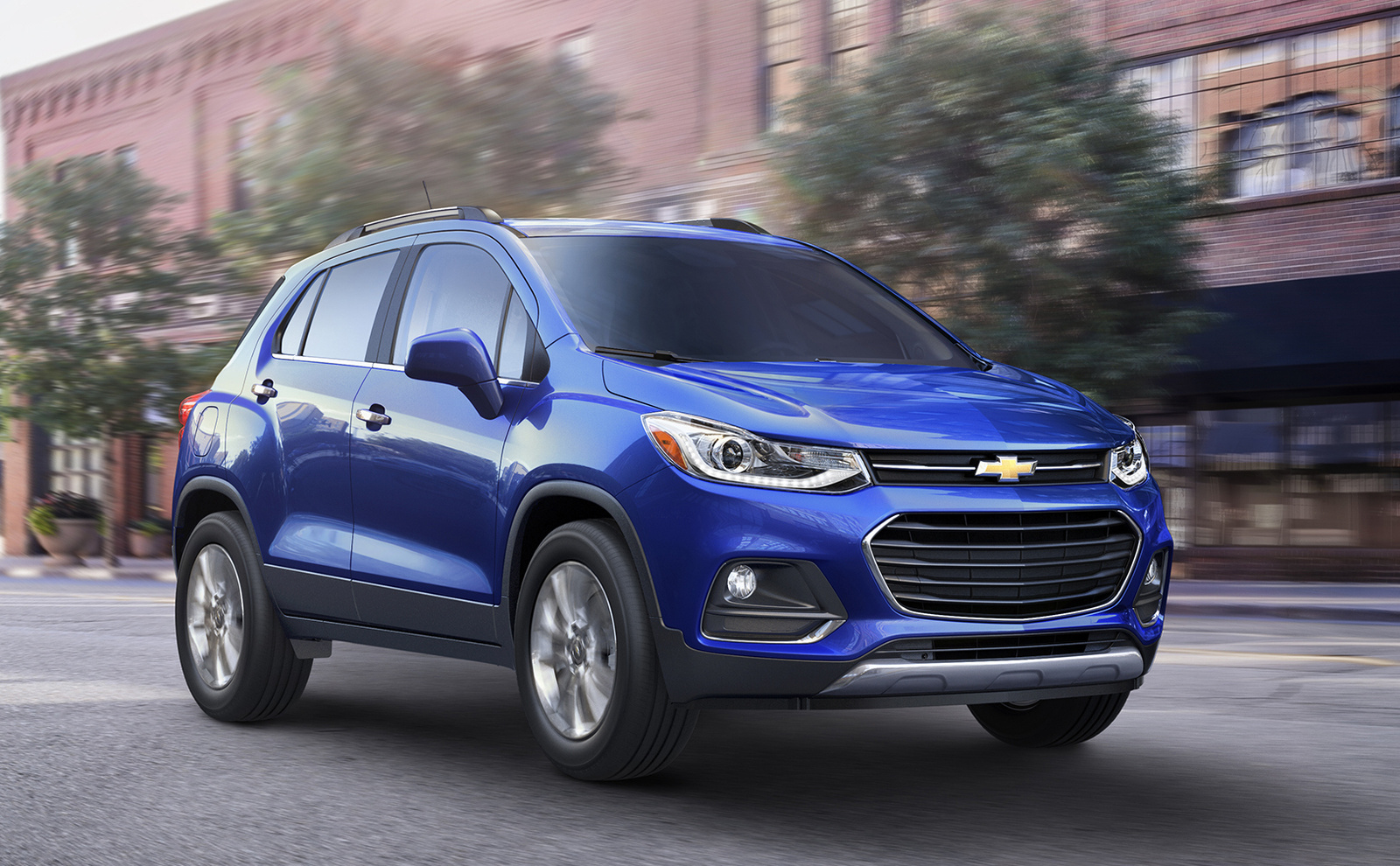
Pathological test drives a small Chevy Crossover


Image result for chevy trax 2017 no copyright image

The Chevy Trax has a lot to prove with heavy hitters like the Honda CR-V and Subaru XV.

The sole engine option is a 1.5-liter turbocharged four-cylinder pumping out 138hp. You’d think that with the turbo that there is a bit more flexibility thanks to the high torque at low revs, but it still feels sluggish. Our guess is that our tester car came equipped with all-wheel-drive and that may have hampered acceleration slightly, we haven’t had the opportunity to test drive a front-wheel-drive version. The engine isn’t all bad though, running costs are low which does help make it appealing; while driving around town at normal speeds really does show how smooth and relaxed the engine can be when not rushed in the way we drove down the expressway. There’s something about a turbo engine car that we have to flat out flog it at least once to see what it can really do. It’s not a bad engine but just a little short on puff where some will find it a deal breaker and others won’t care at all.

Driving the Trax around town is actually fairly easy. Steering is light and offers decent feedback where it matters most when just darting through traffic or squeezing in and out of tight parking spaces. We just wish that the steering offered more feedback when on faster paced roads because it does feel a little disconnected at times. The ride comfort in our tester car was a little more on the firm side which is partially due to the 18-inch alloys that it came equipped with and well that didn’t translate well in road noise either because it did feel a little bit noisier than we’d like. Driving on the highway is also comfortable at relaxed speeds, we do feel that the tall and narrow body gets blown about a bit more than some of its rivals but it’s not a deal breaker in our books.

The infotainment screen is fairly easy to navigate, even though we do find that many of the menus can be distracting while on the go. The front seats offer plenty of adjustment and support while those in the rear may feel a little short changed on the space, it’s not bad but it’s not particularly roomy as well. The boot space is a little disappointing; some rivals of similar size have way more space to spare. Visibility is good all round.

Standard LS trim comes with rearview parking camera, remote keyless entry, auto headlights and Bluetooth audio streaming for your mobile device. LT trim adds 16-inch alloy wheels, LED tail lamps, integrated roof rails and remote start. Top of the range Premier trim (our tester car) came equipped with leatherette seating, 18-inch alloy wheels, Bose premium audio system and keyless entry and push button start.

The Chevy Trax is an okay option among the crowded compact crossover options. It’s not as versatile as the Honda HR-V and it certainly isn’t as fun to drive as a Nissan Juke. We do wish that Chevy used the turbo engine from the Cruze and we also wish that Chevy could’ve put alloy wheels on the standard LS trim because steel capped wheels on a car $20k or higher is just unacceptable in our books.

Likes: Low running costs. Exterior and interior looks have been improved. It’s quite easy to navigate around town and headroom is actually quite good.

Dislikes: The turbo engine is not as flexible as we’d like. The interior feels narrow and the boot space is disappointingly small.

Our pick: We’d go right for LT trim which adds alloy wheels, remote start and LED tail lamps. It may not have the fancy gadgets of the Premier trim but it’s cheaper and makes the most sense.

Sunday, July 8, 2018

Cheapest BMW, shortchanged on BMW experience?

The X1 was a bit of an oddball when it was first launched. It wasn’t that much cheaper than an X3 and the interior didn’t even live up to the standards that BMW had set. Fast forward to the newest generation of the X1 and you will either love it or loathe it. In simpler times it’s no longer rear wheel drive. Has BMW sold its soul?

Image result for 2017 bmw x1 no copyright
The sole 2-liter turbocharged four-cylinder engine offers plenty of flexibility thanks to high torque at low revs. You won’t feel short changed on power either, but those seeking more power will have to venture to the Mercedes GLA AMG. We feel that this engine is enough for this car. It doesn’t feel underpowered and it certainly is quick on its toes when you need it to be. We love how the combination of comfort and sport translates well around town and on the highway. You will love driving the X1 in tight corners and bends, as it handles them well. You’ll almost forget that the X1 uses a front wheel drive Mini Platform. The engine is also used in the JCW tuned Minis. Steering feedback is generally responsive and well sorted and the ride comfort on some surfaces is a little firm, this highly depends if you stick with the standard alloys and don’t option for the larger 19-inch alloys like our tester car has.

The front seats offer plenty of support and adjustment while there’s plenty of headroom and legroom. Those in the rear seat will also find that comfort and space is generous. The boot space is actually quite good considering that the X1 size. The infotainment screen is easy to navigate through, with all the controls and dials within reach of the driver’s hand. We love the minimalistic approach the interior but some could easily say that it’s a bit boring looking compared to rivals from Audi and Mercedes. We can say that it is easier to navigate through and the materials do feel just as classy.

Our tester car came kitted with electronic stability control, dual zone climate control, rain sensing windshield wipers and split folding rear seat. Optional extras included a business navigation system, cold weather package along with driving assistance package. We wish that our tester car came with the optional LED headlights because the standard halogen headlamps are weak in comparison and are not up to BMW Standards.

You won’t feel shortchanged with the X1 until you look at indirect rivals for similar money. Badge snobs won’t care because it’s a BMW and that’s all that matters.

Likes: It’s the cheapest of the BMW crossover range. The turbo engine is smooth and has low running costs. We love this one more than the previous generation X1.

Dislikes: Front-wheel-drive platform may scare off BMW Purists. We would love to see an M-tuned version.

Saturday, November 25, 2017

Devon test drives his top pick in compact crossovers

Image result for nissan rogue no copyright image

This will be the shortest intro ever. The Nissan Rogue is our top pick in the compact crossover segment. Here’s why.

Performance: The only engine choice offered with the Rogue is a 2.5-liter four-cylinder producing 170hp mated to a continuously variable transmission. This engine is all you’ll ever really need. There’s plenty of pick up around town and on the highway. Plus fuel economy is actually really good too. We’d personally prefer a diesel engine option but that would be nitpicking.
On the road: The Rogue isn’t as sharp to drive as a Volkswagen Tiguan or Ford Escape but it does its intended job well. Around town the ride comfort can be a bit jittery but it’s far from annoying. On the highway the ride comfort smoothens out. Steering is communicative and weighs up nicely. Refinement is one of the Rogue’s strong points. Road and wind noise are well suppressed. You’d think that you were in a more expensive luxury crossover. The CVT transmission often at times makes the engine sound buzzy but this is far from intrusive.

Behind the wheel: There’s plenty of adjustment for the driver to get comfortable behind the wheel of the Rogue. Everything in the dashboard is easy to reach and logically placed. The infotainment screen can be distracting at first but once you get used to it, it becomes a breeze to operate. The Rogue is the best choice for small families that need versatility. There’s plenty of space for five with a spacious boot. If you need to carry two extra people you can option for a third-row seat. Although it is nice that Nissan offers this. The third row is best left for kids or short journeys for adults.
Equipment: The Rogue is well equipped for the money. Standard S trim has Bluetooth, rear-view parking camera and LED daytime running lamps. SV trim adds push button start, 17inch alloy wheels and dual zone automatic climate control. Top of the range SL trim adds 18inch alloy wheels, navigation system and leather appointed seats. All-wheel-drive is optional across the range.

Buying & Owning: The Rogue is priced roughly with its competition which may seem a bit pricey. But with strong resale value you will be reassured of your investment. Fuel economy is actually best in class so your running costs should be low if you stick with the two-wheel-drive form. We think the all-wheel-drive option is best avoided unless you really need the extra traction.
Quality & safety: Everything feels so solid and well built in the cabin. Many of the materials used feel classy and long lasting. Nissan has scored very well in reliability as well. All versions of the Rogue have six-airbags, stability control and emergency brake assist. Lane-departure warning as well as collision warning systems is offered as an option. Immobilizer helps protect against thieves.

The Nissan Rogue is a compelling option in a sea of compact crossovers. If you are looking for the most sensible choice with good fuel economy, snazzy looks and is well put together. The Nissan Rogue is the perfect choice. So it’s no wonder why it is our top pick for compact crossovers.
Likes: Fuel economy is best in class. Exterior and interior are classy and well put together. Third row seat can be had as an option for the Rogue.

Dislikes: A diesel engine option or a more powerful engine option would be nice. But these are just nitpicks really.
Devon’s Pick: SV trim offers keyless start, 17inch alloy wheels and automatic climate control. You may have to pay extra for this trim. But we feel that this one offers the best overall compared to the S and SL.