What's On

Showing posts with label LGBT-Community. Show all posts

Wednesday, April 18, 2018

Pride Month: Britney Spears song facts


WORK BITCH by BRITNEY SPEARS

This club banger was released as the first single off Britney Spears' eighth album. It was written by:

Black Eyed Peas frontman will.i.am, who executive-produced the record.

Swedish DJ and music producer Otto Knows, who had a Europe-wide hit with his song, "Million Voices."

Irish singer-songwriter, Ruth-Anne Cunningham, who at the age of 17 won an ASCAP Pop Award for co-penning JoJo's hit "Too Little, Too Late."

Anthony Preston, who has worked closely with Will.i.am as well as with co-penning Nicole Scherzinger's "Boomerang."

Sebastian Ingorsso of the EDM trio Swedish House Mafia was also listed as a songwriter, but spoke out to distance himself from the track. He explained that he passed along a song created by his protégé Otto Knows to the Black Eyed Peas frontman for Spears' new project. "I don't really know why they put my name in there," Ingrosso told Billboard magazine. "It's a really good song and I'm looking forward to what's going to happen with it. But I can't really take credit for it."

Ingrosso previously worked with will.i.am on his 2012 UK chart-topper, "This is Love" alongside his SDM colleague Steve Angello and Swedish hitmaker Max Martin.

The club ready tune opens with Spears giving fans a pep talk about releasing their potential:

"You want a hot body?
You want a Bugatti?
You want a Maserati?
You better work bitch!"

Britney previously used the 'b' word when she introduced her 2007 single "Gimme More" with the iconic phrase "It's Britney, bitch." Will.i.am later interpolated a sample of the phrase on his 2012 collaboration with Spears, "Scream & Shout."

Britney assumes a British accent in this song, perhaps because her name is BRITney, but possibly so she could let loose in character like Nicki Minaj does in some of her songs (Nicki also uses the accent in interviews from time to time). Madonna and Lady Gaga have both been known to speak in the British tongue from time to time as well, so this certainly has precedent.

The "you better work" call to action and its variant "work it" were popularized by RuPaul, who before his bout with reality TV stardom on the show RuPaul's Drag Race had a 1993 Dance hit (#45 on the Hot 100) with "Supermodel," where he used "work" in the fashionista sense where it means to present yourself with confidence, especially on the runway. The phrase "Work It" wormed its way into the popular lexicon as encouragement for just about any kind of performance, but Britney uses it in a far more literal sense, explaining that a hot body requires hard work, as does the attainment of luxury goods.

The song title and lyrics caused some radio programmers concern, leading to some stations playing an edited version titled "Work Work." It's not the first Britney release to be censored - the video for her racy chart-topping single "3" substituted the word "this" for the word "sin" during the pre-chorus.

The steamy music video was directed by Ben Mor ("Scream & Shout") and shot between September 7-10 in Malibu, California. The S&M themed clip finds Britney portraying a dominatrix bad girl who seductively whips her dancers into shape. Mor commented: "You can't have soft visuals for a song called 'Work Bitch,' and we sure as hell didn't."

Spears admitted during an interview with the TJ Show on Boston's AMP 103.3 that she toned down what was originally filmed. "We showed way more skin and did way more stuff for the video than what is actually there," Spears said. "I cut out, like, half the video because I am a mother; I have children. And it's hard to play sexy mom while you're being a pop star as well, but I have to just be true to myself and feel it out when I do stuff."

Despite being released as the lead single from Britney Jean, the album doesn't necessarily take all of its cues from the tune's vibe. "That song is a reflection of Britney more so than the album," will.i.am told Billboard magazine. "The album is what the album is, but we felt that song needed to come out to keep the foundation on what Britney represents. But it shouldn't reflect the album -- an album is a body of work as a collective. If we had to pick a song like, 'Oh, what song fits every color of the record,' you shouldn't do that… We felt that song represents 'Piece Of Me,' that Britney oomph."

Asked about her use of the word bitch in this song, Britney explained to UK chat show host Alan Carr that it was a reference for her gay following. "I don't call everyone… that word. I just use it as, it's like in respect to the gays as a term of endearment," she said. "It's like a street slang for everyone, you know, like you get to work, that's what you do when you get to work and it's like, cool."

Britney told Alan Carr that she had expert tuition for the scene in the song's video where she whips one of the dancers. "We had a whip instructor come in and actually show me how to use it, and actually bring it around the back of my head, and actually use it, and it you do it the wrong way you can actually hurt yourself and cut yourself with it, because it's really powerful," she said. "They're really strong."

GIMME MORE by BRITNEY SPEARS

This was Britney's first single release since her very public divorce from Kevin Federline and subsequent meltdown, when she lost custody of her children and made various court appearances.

Spears performed this to open the 2007 MTV Video Music Awards. As soon as she turned to look at the audience, she seemed to freeze up and struggled through a very stiff performance which was mocked by a number of media outlets. Despite this performance, the song proved to be Spears' most successful single in the US since her debut hit "Baby One More Time," achieving Golden Status with more than 500.000 copies sold in just 4 weeks.

The song was produced and co-written by Timbaland protégé Nate "Danja" Hills.

This opens with Spears saying, "It's Britney Bitch." MTV had the exclusive rights to sell the ringtone of this phrase.

Co-writer Jim Beanz came up with the expression. He told MTV UK: "She was amazing to work with, she is a very hard worker. Just as hard as she works on her dance steps she is the exact same in the booth. She was basically open to any and everything that I mentioned. The phrase came last minute right at the end of the session. We recorded that while she was pregnant with her second child. It was really difficult to try to make her sound really sexy an at the same time she was pregnant. We knew that as soon as she had the baby she was the one to be able to push that song. We needed that one catch phrase to really bring her back and put her stamp on the industry and that stamp was 'It's Britney Bitch.'"

This was only the second Top 3 US hit for Spears. Her first was her debut single "Baby One More Time."

This was co-written by Keri Hilson, who also contributed to three other songs on Blackout. Hilson developed a nickname for Britney, "One-Take Jake." She explained to Rolling Stonemagazine: "With Britney, I need to get as much of any song done as I can [before she enters the studio]. She likes to record quickly, partly because she doesn't like to stand up for too long."

The song's music video was filmed over a two day period in July 2007 at a warehouse in downtown Los Angeles. It was directed by Jake Sarfaty, who was handpicked by Spears. According to makeup artist Mikal Sky, who worked personally with Spears on the clip, the singer refused to follow the agreed script. "She had just shaved her head and was getting nothing but bad press," Sky told Money Making Makeup Artist. "She sabotaged the director by refusing to perform and follow the script. So, what we got was her dancing on a stripper pole with her friends."

I WANNA GO by BRITNEY SPEARS

This Max Martin and Shellback penned up-tempo number features a Euro-pop whistle motif. The song was one of seven that co-executive producer Max Martin contributed to Femme Fatale and his relationship with Spears goes way back to her debut single, "…Baby One More Time," which he wrote. Spears told Rolling Stone why the Swedish hitmaker gets the best out of her: "Max played a huge role on this album and he has been there since the beginning so there is such a huge level of trust. He gets exactly what I am saying when I tell him what I want and don't want musically. His melodies are incredible and he is always coming up with weird sounds, which I love. The whistle on 'I Wanna Go' still gets me every time I hear it. Who would have thought of that? There is nobody I feel more comfortable collaborating with in the studio."

The Chris Marrs Piliero directed video was filmed in Los Angeles, California and finds Britney poking fun at the idea of the sexy pop star. It co-stars Weeds and Half Baked actor Guillermo Diaz as the convertible driver.

One of many pop culture references that litter the video is a movie theater marquee that reads "Crossroads 2: Cross Harder," alluding to the 2002 film, in which Britney had her first major role. Piliero told the New York Post it was, "a fun Easter egg for fans. Plus, Die Hard 2: Die Harder is the most ridiculously awesome way to title a sequel. It just felt like the right thing to do. When Britney saw it, she loved it."

IF U SEEK AMY by BRITNEY SPEARS

This is Spears' raunchiest tune to date mainly because its title is a sneaky way of saying "F--K Me." The song has upset a number of parents who bought Circus for their young children only to find them walking around the house singing what sounds like the F word. This clever wordplay isn't totally original; both Memphis Slim and April Wine have songs called "If You See Kay."

The "ha ha hee hee" chorus is appropriate to the album's carnival theme.

This was written by the Swedish songwriters Max Martin, Shellback and Alexander Kronlund, along with the Texan Savan Kotecha. Martin, who wrote and produced Spears' first hit "Baby One More Time," also produced this track.

An edited version called "If U See Amy" was quickly released when some radio stations refused to play the original.

Co-writer Savan Kotecha comes from a very traditional Indian family. He recalled to Music Business Worldwide their horrified reaction when this song was released:

"My mum saw it and she called me and was like [upset voice]: 'My friend's son is becoming a doctor. And my son? My son is writing pop songs about sex!!!'

Then my dad got on the line and was like, 'You're being indecent.' I wasn't allowed to have a girl call my house until I was an adult. So maybe a lot of pent-up sexual stuff comes out in my songs… and that's quite a foreign thing to my parents."

OOH LA LA by BRITNEY SPEARS

This song plays at the end credits of The Smurfs 2 movie. Britney had her own two children, Sean and Preston in mind when she agreed to record the tune. "I have always loved the Smurfs as a kid and now my boys are the biggest Smurfs fans EVER," she said. "I wanted to surprise them with a song in the movie. I know they'll think it's Smurftastic!"

The song was penned by hitmaker Bonnie McKee ("Hold It Against Me") along with J Kash, Lola Blanc and Fransisca Hall and produced by Spears' Femme Fatale collaborators Dr. Luke, Ammo and Cirkut. Los Angeles-based singer-songwriter Lola Blanc told Idolator: "We originally wrote 'Ooh La La' for me — it was me, Fran Hall and Ammo. I came up with the title, which was sort of a play on my name, and then Dr. Luke heard it and was like, 'I want this for Britney!'"

Britney is not the only music superstar to contribute to the movie - Katy Perry returns to repeat her role as the voice of Smurfette in the CGI sequel.

Britney's two sons, Sean and Jayden, made cameos in the song's music video. They were 7 and 6 years old at the time, a younger age than their mom when she made her showbiz debut on Star Search at the age of 10. Britney told Ryan Seacrest that during filming, her kids were pros. "They were actually really, really good on set," she told the radio presenter. "They were, like, acting, and my oldest son, Preston, was right on cue every time they would tell him to do something. Later on I got to see what they actually did on camera and it was adorable."

Britney explained the song's meaning to Ryan Seacrest on his radio show. "It's about feeling good," she said. "Like when a guy makes you giddy. It's more of a feeling. When I eat chocolate I have that 'ooh la la' feeling."

Bonnie McKee and her frequent collaborator, Katy Perry, secretly recorded background vocals on the song. Katy and Britney didn't meet as they laid down their parts separately.

McKee's contribution was to tweak the lyrics to make them family friendly. "I actually came in and was the doctor behind it. A lot of it was already written. It was a great song to begin with. ... They wanted it for the Smurfs movie, and it was originally pretty sexy," she recalled to MTV News. "I was like, 'OK, how do I take this sex-drenched song and make it Smurfs friendly?'"

"That was kind of my task, but it still had to work at radio and be something that people would buy as a Britney Spears song because she's not a Smurf," McKee added. "So, it was just kind of fun to find double entendres to put in there and kind of trick the parents into thinking it's kid friendly."

Friday, September 22, 2017

Pride Month: History behind the Rainbow Flag


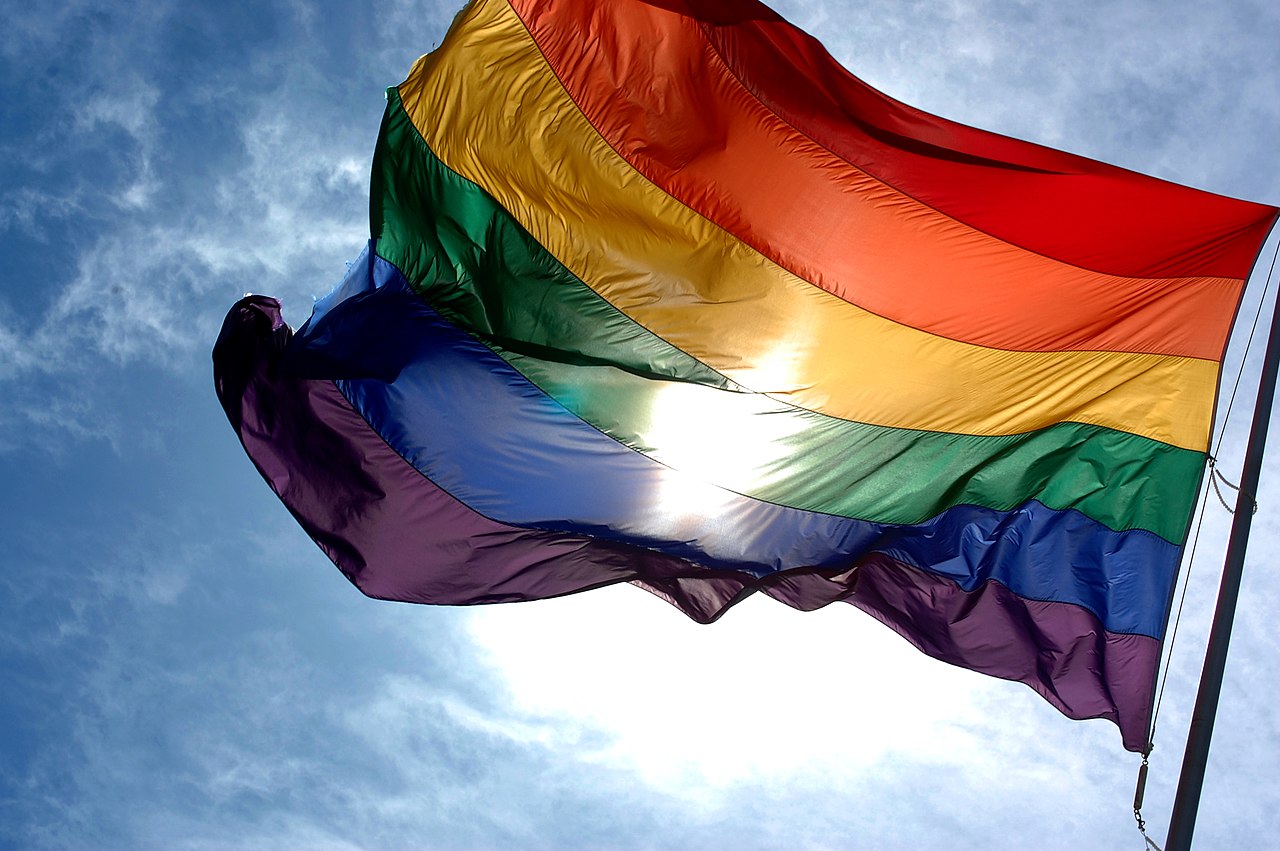
The rainbow flag, commonly known as the gay pride flag or LGBT pride flag, is a symbol of lesbian, gay, bisexual, and transgender (LGBT) pride and LGBT social movements. (Other uses of rainbow flags include a symbol of peace.) The colors reflect the diversity of the LGBT community, and the flag is often used as a symbol of gay pride during LGBT rights marches. While it originated in Northern California, the flag is now used worldwide.

Originally devised by San Francisco artist Gilbert Baker, the design has undergone several revisions since its debut in 1978, first to remove colors then restore them based on availability of fabrics. The most common variant consists of six stripes: red, orange, yellow, green, blue, and violet. The flag is typically flown horizontally, with the red stripe on top, as it would be in a natural rainbow.

Gilbert Baker, an openly gay activist born in 1951, grew up in Parsons, Kansas, and went on to serve in the US army for about two years in 1970. After an honorable discharge, Gilbert taught himself to sew. In 1974, Baker met Harvey Milk, an influential gay leader, who three years later challenged Baker to come up with a symbol of pride for the gay community. The original gay pride flag flew in the San Francisco Gay Freedom Day Parade on June 25, 1978. It has also been suggested that Baker may have been inspired by Judy Garland's singing "Over the Rainbow" and the Stonewall riots that happened a few days after Garland's death (she was one of the first gay icons). Another suggestion for how the rainbow flag originated is that at college campuses during the 1960s, some people demonstrated for world peace by carrying a Flag of the Races (also called the Flag of the Human Race) with five horizontal stripes (from top to bottom they were red, white, brown, yellow, and black). Gilbert Baker is said to have gotten the idea for the rainbow flag from this flag in borrowing it from the Hippie movement of that time largely influenced by pioneering gay activist Allen Ginsberg. The flag originally comprised eight stripes; Baker assigned specific meaning to each of the colors

Thirty volunteers hand-dyed and stitched the first two flags for the parade.

After the assassination of gay San Francisco City Supervisor Harvey Milk on November 27, 1978, demand for the rainbow flag greatly increased. To meet demand, the Paramount Flag Company began selling a version of the flag using stock rainbow fabric with seven stripes: red, orange, yellow, green, turquoise, blue, and violet. As Baker ramped up production of his version of the flag, he too dropped the hot pink stripe because of the unavailability of hot-pink fabric. Also, San Francisco-based Paramount Flag Co. began selling a surplus stock of Rainbow Girls flags from its retail store on the southwest corner of Polk and Post, at which Gilbert Baker was an employee.

In 1979 the flag was modified again. When hung vertically from the lamp posts of San Francisco's Market Street, the center stripe was obscured by the post itself. Changing the flag design to one with an even number of stripes was the easiest way to rectify this, so the turquoise stripe was dropped, which resulted in a six stripe version of the flag — red, orange, yellow, green, blue, and violet.

In 1989, the rainbow flag came to nationwide attention in the United States after John Stout sued his landlords and won when they attempted to prohibit him from displaying the flag from his West Hollywood, California, apartment balcony.

For the 25th anniversary of the Stonewall Riots in 1994, flag creator Baker was commissioned to create the world's largest rainbow flag. It took months of planning and teams of volunteers to coordinate every aspect. The flag utilized the basic six colors and measured thirty feet wide. Foot-wide sections of the flag were given to individual sponsors as part of a fundraiser for the Stonewall anniversary event once the event had ended. Afterwards additional large sections of the flag were sent with activists and they were used in pride parades and LGBT marches worldwide. The Guinness Book of World Records confirmed it as the world's largest flag.

In 2003 Baker was again commissioned to produce a giant flag. In this case it marked the 25th anniversary of the flag itself. Dubbed "25Rainbow Sea to Sea" the project entailed Baker again working with teams of volunteers but this flag utilized the original eight colors and measured a mile-and-a-quarter (2 km) across Key West, Florida from the Atlantic Ocean to the Gulf Coast Sea. The flag was again cut up afterward, and sections sent to over a hundred cities worldwide.

In 2000, the University of Hawaii at Manoa changed its sports teams' name from "Rainbow Warriors" to "Warriors" and redesigned its logo to eliminate a rainbow from it. Initially Athletic Director Hugh Yoshida said that the change was to distance the school's athletic program from homosexuality. When this drew criticism, Yoshida then said the change was merely to avoid brand confusion. The school then allowed each team to select its own name, leading to a mix including "Rainbow Warriors", "Warriors", "Rainbows" and "Rainbow Wahine". This decision was reversed in May 2013, when current athletic director Ben Jay reversed his earlier decision in February to force all of the men's athletic teams to be just Warriors from the patchwork of names from dropping the Rainbow Warriors name.

The rainbow flag celebrated its 25th anniversary in 2003. During the gay pride celebrations in June of that year, Gilbert Baker restored the rainbow flag back to its original eight-striped version and has since advocated that others do the same. However, the eight-striped version has seen little adoption by the wider gay community, which has mostly stuck with the better known six-striped version.

In autumn 2004 several gay businesses in London were ordered by Westminster City Council to remove the rainbow flag from their premises, as its display required planning permission. When one shop applied for permission, the Planning sub-committee refused the application on the chair's casting vote (May 19, 2005), a decision condemned by gay councillors in Westminster and the then Mayor of London, Ken Livingstone. In November the council announced a reversal of policy, stating that most shops and bars would be allowed to fly the rainbow flag without planning permission.

Today some LGBT individuals and straight allies put rainbow flags in the front of their yards and/or front doors, or use rainbow bumper stickers on their vehicles to use as an outward symbol of their identity or support.

In June 2004 LGBT activists sailed to Australia's uninhabited Coral Sea Islands Territory and raised the rainbow flag, proclaiming the territory independent of Australia, calling it the Gay and Lesbian Kingdom of the Coral Sea Islands. The rainbow flag is the official flag of the kingdom.

In June 2015, The Museum of Modern Art acquired the rainbow flag symbol as part of its design collection.

On June 26, 2015, the White House was illuminated in the rainbow flag colors to commemorate the legalization of same-sex marriages in all 50 U.S. states, following the Obergefell v. Hodges Supreme Court decision.

On April 20, 2017, advertising agency Ogilvy & Mather announced the release of a commemorative, rainbow-colored font named "Gilbert Color", designed in collaboration with software company Fontself. The font is freely distributed under a Creative Commons license.

On June 8, 2017, the US city of Philadelphia adopted a revised version of the flag. The design adds black and brown stripes to the top of the standard six-color flag, "to highlight black and brown LGBTQIA members within [the city's] community".

Many variations of the rainbow flag have been used. Some of the more common ones include the Greek letter lambda (lower case) in white in the middle of the flag and a pink triangle or black triangle in the upper left corner. Other colors have been added, such as a black stripe symbolizing those community members lost to AIDS. The rainbow colors have also often been used in gay alterations of national and regional flags, replacing for example the red and white stripes of the flag of the United States. In 2007, the Pride Family Flag was introduced at the Houston, Texas pride parade.

In the early years of the AIDS epidemic, AIDS activists designed a "Victory over AIDS" flag consisting of the standard six-stripe rainbow flag with a black stripe across the bottom. Leonard Matlovich, himself dying of AIDS-related illness, suggested that upon a cure for AIDS being discovered, the black stripes be removed from the flags and burned.

LGBT communities in other countries have also adopted the rainbow flag. A South African gay pride flag which is a hybrid of the rainbow flag and the national flag of South Africa was launched in Cape Town in 2010. Flag designer Eugene Brockman said "I truly believe we (the LGBT community) put the dazzle into our rainbow nation and this flag is a symbol of just that."

The rainbow flag has found wide application on all manner of products. The rainbow flag colors are routinely used as a show of LGBT identity and solidarity. The rainbow colors have become so widely recognized as a symbol of LGBT pride and identity that they have effectively replaced most other LGBT symbols, including the Greek letter lambda and the pink triangle. One common item of jewelry is the pride necklace or freedom rings, consisting of six rings, one of each color, on a chain. Other variants range from key chains to candles. In Montreal, the entrance to Beaudry metro station, which serves that city's Gay Village, was rebuilt in 1999 with rainbow-colored elements integrated into its design.

In early October 2010, Canadian teenager Brittany McMillan promoted a new LGBTQ awareness day called Spirit Day. The first observance of Spirit Day was on October 20, 2010; it now takes place on October 15. On this day people wear the color purple to show support for LGBT youth who are victims of bullying. Spirit Day comes from the violet stripe of the rainbow flag, which represents spirit.

Thursday, September 14, 2017

Pride Month: LGBT-Symbols


The LGBT community has adopted certain symbols for self-identification which demonstrate unity, pride, shared values, and allegiance to one another. LGBTQ symbols communicate ideas, concepts, and identity both within their communities and to mainstream culture. The two most-recognized international LGBTQ symbols are the pink triangle and the rainbow flag. The pink triangle, employed by the Nazis in World War II as a badge of shame, was re-appropriated but retained negative connotations. The rainbow flag, previously used as a symbol of unity among all people, was adopted to be a more organic and natural replacement without any negativity attached to it.

One of the oldest of these symbols is the pink triangle, which originated from the Nazi concentration camp badges that male homosexuals were required to wear on their clothing. Many of the estimated 5–15,000 gay men and lesbian women imprisoned in concentration camps died during the Holocaust. The pink triangle was later reclaimed by gay people and sometimes lesbians in various political movements as well as a symbol of personal pride. AIDS Coalition to Unleash Power (ACT-UP) adopted the inverted pink triangle to symbolize the "active fight back" against HIV/AIDS "rather than a passive resignation to fate."

The pink triangle was used exclusively with male prisoners—lesbians were not included under Paragraph 175, a statute which made homosexual acts between males a crime. The United States Holocaust Memorial Museum stipulates that this is because women were seen as subordinate to men, and that the Nazi state feared lesbians less than gay men. However, the USHMM also claims that many women were arrested and imprisoned for "asocial" behaviour, a label which was applied to women who did not conform to the ideal Nazi image of a woman: cooking, cleaning, kitchen work, child raising, and passivity. These women were labeled with a black triangle. Some lesbians reclaimed this symbol for themselves as gay men reclaimed the pink triangle.Many lesbians also reclaimed the pink triangle

The pink triangle was originally used to denote homosexual men as a Nazi concentration camp badge.

The black triangle was used to mark "asocial" and "workshy" individuals, including lesbians, Romani and others in the camps. It has been adapted as a lesbian symbol.

The pink triangle overlapping a yellow triangle was used to tag Jewish homosexuals in Nazi concentration camps.

The labrys, or double-bladed battle axe, was a symbol used in the ancient civilization of Minoan Crete (sometimes portrayed as having certain matriarchal tendencies). Today it is used to represent lesbian and feminist strength and self-sufficiency. It has been in use since the late 1970s. Some lesbians have it tattooed on their inner wrist while others wear it as a pendant.

n the early 1970s, graphic designer Tom Doerr selected the Greek letter lambda to be the symbol of the New York chapter of the Gay Activists Alliance. The alliance's literature states that Doerr chose the symbol specifically for its denotative meaning in the context of chemistry and physics: "a complete exchange of energy–that moment or span of time witness to absolute activity". Within the STEM field, the lambda symbol is associated with the half-life parameter of exponential random variables, which describes the time it takes for a state to change.

In December 1974, the lambda was officially declared the international symbol for gay and lesbian rights by the International Gay Rights Congress in Edinburgh, Scotland. The gay rights organization Lambda Legal and the American Lambda Literary Foundation derive their names from this symbol.

On 31 October 1969, sixty members of the Gay Liberation Front (GLF) and the Society for Individual Rights (SIR) staged a protest outside the offices of the San Francisco Examiner in response to another in a series of news articles disparaging LGBT people in San Francisco's gay bars and clubs. The peaceful protest against the "homophobic editorial policies" of the Examiner turned tumultuous and were later called "Friday of the Purple Hand" and "Bloody Friday of the Purple Hand". Examiner employees "dumped a bag of printers' ink from the third story window of the newspaper building onto the crowd". Some reports state that it was a barrel of ink poured from the roof of the building. The protesters "used the ink to scrawl 'Gay Power' and other slogans on the building walls" and stamp purple hand prints "throughout downtown San Francisco" resulting in "one of the most visible demonstrations of gay power". According to Larry LittleJohn, then president of SIR, "At that point, the tactical squad arrived – not to get the employees who dumped the ink, but to arrest the demonstrators. Somebody could have been hurt if that ink had gotten into their eyes, but the police were knocking people to the ground." The accounts of police brutality include women being thrown to the ground and protesters' teeth being knocked out.

Inspired by Black Hand extortion methods of Camorra gangsters and the Mafia, some gay and lesbian activists attempted to institute "purple hand" as a warning to stop anti-gay attacks, with little success. In Turkey, the LGBT rights organization MorEl Eskişehir LGBTT Oluşumu (Purple Hand Eskişehir LGBT Formation), also bears the name of this symbol.

Gilbert Baker designed the rainbow flag for the 1978 San Francisco Gay Freedom Celebration. The flag does not depict an actual rainbow. Rather, the colors of the rainbow are displayed as horizontal stripes, with red at the top and violet at the bottom. It represents the diversity of gays and lesbians around the world. In the original eight-color version, pink stood for sexuality, red for life, orange for healing, yellow for the sun, green for nature, turquoise for art, indigo for harmony, and violet for the soul. The original eight-color rainbow flag flies over the Castro in San Francisco and from the Lesbian, Gay, Bisexual, and Transgender Community Center in New York City.

Freedom rings, designed by David Spada, are six aluminum rings, each in one of the colors of the rainbow flag. They were released in 1991. Symbolizing happiness and diversity, these rings are worn by themselves or as part of necklaces, bracelets, and key chains. They are sometimes referred to as "Fruit Loops".

The pansexual pride flag has been found on various Internet sites since mid-2010. It has three horizontal bars that are pink, yellow and blue. The pink band symbolizes women; the blue, men; and the yellow, those of a non-binary gender, such as agender, bigender or genderfluid.

Modifications of the classical gender symbols (based on astrological symbols, Mars for male and Venus for female) have appeared to express various LBGT gender identities since the 1990s. Two interlocking male symbols form a gay male symbol. Two interlocking female symbols form a lesbian symbol.

A transgender symbol is the Transgender Pride flag designed by transgender woman Monica Helms in 1999 and was first shown at a pride parade in Phoenix, Arizona, USA in 2000. It was flown from a large public flagpole in San Francisco's Castro District beginning November 19, 2012 in commemoration of the Transgender Day of Remembrance. The flag represents the transgender community and consists of five horizontal stripes: two light blue, two pink, with a white stripe in the center. Helms described the meaning of the flag as follows:

The stripes at the top and bottom are light blue, the traditional color for baby boys. The stripes next to them are pink, the traditional color for baby girls. The stripe in the middle is white, for those who are intersex, transitioning or consider themselves having a neutral or undefined gender. The pattern is such that no matter which way you fly it, it is always correct, signifying us finding correctness in our lives

Philadelphia became the first county government in the U.S. to raise the transgender pride flag in 2015. It was raised at City Hall in honor of Philadelphia's 14th Annual Trans Health Conference, and remained next to the US and City of Philadelphia flags for the entirety of the conference. Then-Mayor Michael Nutter gave a speech in honor of the trans community's acceptance in Philadelphia.

Also under the trans or transgender umbrella are all those who identify off the gender binary. There are many different identities within this category including genderqueer, two-spirit, gender fluid, third gender, and androgyny.

Intersex people are those who do not exhibit all the biological characteristics of male or female, or exhibit a combination of characteristics, at birth. Between 0.05% and 1.7% of the population is estimated to have intersex traits.

The Intersex flag was created by Organisation Intersex International Australia in July 2013 to create a flag "that is not derivative, but is yet firmly grounded in meaning". The organisation aimed to create a symbol without gendered pink and blue colors. It describes yellow and purple as the "hermaphrodite" colors. The organisation describes it as freely available "for use by any intersex person or organisation who wishes to use it, in a human rights affirming community context".

Bear is an affectionate gay slang term for those in the bear communities, a subculture in the gay community and an emerging subset of the LGBT community with its own events, codes, and culture-specific identity. Bears tend to have hairy bodies and facial hair; some are heavy-set; some project an image of working-class masculinity in their grooming and appearance, though none of these are requirements or unique indicators. The bear concept can function as an identity, an affiliation, and an ideal to live up to. There is ongoing debate in bear communities about what constitutes a bear. Some state that self-identifying as a bear is the only requirement, while others argue that bears must have certain physical characteristics, such as a hairy chest and face, a large body, or a certain mode of dress and behavior.

Bears are almost always gay or bisexual men; transgender men (regardless of their sexuality) and those who shun labels for gender and sexuality are increasingly included within bear communities. The bear community has spread all over the world, with bear clubs in many countries. Bear clubs often serve as social and sexual networks for older, hairier, sometimes heavier gay and bisexual men, and members often contribute to their local gay communities through fundraising and other functions. Bear events are common in heavily gay communities.

The International Bear Brotherhood Flag was designed in 1995 by Craig Byrnes.

Butch and femme are terms used in the lesbian and gay subculture to ascribe or acknowledge a masculine (butch) or feminine (femme) identity with its associated traits, behaviors, styles, self-perception and so on. The terms were founded in lesbian communities in the twentieth century. This concept has been called a "way to organize sexual relationships and gender and sexual identity". Butch-femme culture is not the sole form of a lesbian dyadic system, as there are many women in butch–butch and femme–femme relationships.

Both the expression of individual lesbians of butch and femme identities and the relationship of the lesbian community in general to the notion of butch and femme as an organizing principle for sexual relating have varied over the course of the 20th century. Some lesbian feminists have argued that butch–femme is simply a replication of heterosexual relations while other commentators argue that, while it resonates with heterosexual patterns of relating, butch–femme simultaneously challenges it. Research in the 1990s in the United States showed that "95% of lesbians are familiar with butch/femme codes and can rate themselves or others in terms of those codes, and yet the same percentage feels that butch/femme was 'unimportant in their lives'"

The website Butch-Femme.com uses a black triangle in a red circle to represent butch–femme sexuality.

The asexual pride flag consists of four horizontal stripes: black, grey, white, and purple from top to bottom.

In August 2010, after a process of getting the word out beyond the Asexual Visibility and Education Network (AVEN) and to non-English speaking areas, a flag was chosen following a vote on a non-AVEN site. It has since been seen used on Tumblr in various LGBTQ areas, but had been seen alongside other Sexual Orientations flags previous to formal election. The black stripe represents asexuality, the grey stripe representing the grey-area between sexual and asexual, the white stripe sexuality, and the purple stripe community. The AVEN logo is a triangle fading from white to black to symbolise the gradient between sexuals, gray-asexuals, demisexuals, and asexuals. The ace of spades and ace of hearts are also used as asexual symbols since "ace" is a phonetic shortening of asexual. Generally, romantic asexuals use the ace of hearts as their symbol and aromantic asexuals use the ace of spades

In addition to major symbols of the LGBT community, less-popular symbols have been used to represent members’ unity, pride, shared values, and allegiance to one another.

In 19th-century England, green indicated homosexual affiliations. Victorian men would often pin a green carnation on their lapel as popularized by author Oscar Wilde, who often wore one on his lapel.

According to some interpretations, American poet Walt Whitman used the calamus plant to represent homoerotic love.

Bisexual women and lesbians used to give violets to the woman they were wooing, symbolizing their "Sapphic" desire. In a poem, Sappho described herself and a lover wearing garlands of violets. The giving of violets was popular from the 1910s to the 1950s.

In the early 20th century gay men in New York City's caucasian professional world would often wear red neckties to signal their identity.

In the Society for Creative Anachronism, LGBT members often wear a blue feather to indicate an affiliation with Clan Blue Feather, a group of SCA members promoting the study of LGBT culture and people in the Middle Ages. Because of this affiliation, blue feathers have also been used at some Renaissance Faires and Pagan events.

In the United Kingdom, since 2006 the Pink Jack has been widely used to represent a uniquely British LGBT identity.

Wednesday, June 14, 2017

Pride Month: Facts about Pride Parade

The Stonewall riots (also referred to as the Stonewall uprising or the Stonewall rebellion) were a series of spontaneous, violent demonstrations by members of the gay (LGBT) community against a police raid that took place in the early morning hours of June 28, 1969, at the Stonewall Inn, located in the Greenwich Village neighborhood of Manhattan, New York City. They are widely considered to constitute the single most important event leading to the gay liberation movement and the modern fight for LGBT rights in the United States.

Gay Americans in the 1950s and 1960s faced an anti-gay legal system. Early homophile groups in the U.S. sought to prove that gay people could be assimilated into society, and they favored non-confrontational education for homosexuals and heterosexuals alike. The last years of the 1960s, however, were very contentious, as many social/political movements were active, including the Civil Rights Movement, the counterculture of the 1960s, and the anti-Vietnam War movement. These influences, along with the liberal environment of Greenwich Village, served as catalysts for the Stonewall riots.

Very few establishments welcomed openly gay people in the 1950s and 1960s. Those that did were often bars, although bar owners and managers were rarely gay. At the time, the Stonewall Inn was owned by the Mafia. It catered to an assortment of patrons and was known to be popular among the poorest and most marginalized people in the gay community: drag queens, transgender people, effeminate young men, butch lesbians, male prostitutes, and homeless youth. Police raids on gay bars were routine in the 1960s, but officers quickly lost control of the situation at the Stonewall Inn. They attracted a crowd that was incited to riot. Tensions between New York City police and gay residents of Greenwich Village erupted into more protests the next evening, and again several nights later. Within weeks, Village residents quickly organized into activist groups to concentrate efforts on establishing places for gays and lesbians to be open about their sexual orientation without fear of being arrested.

After the Stonewall riots, gays and lesbians in New York City faced gender, race, class, and generational obstacles to becoming a cohesive community. Within six months, two gay activist organizations were formed in New York, concentrating on confrontational tactics, and three newspapers were established to promote rights for gays and lesbians. Within a few years, gay rights organizations were founded across the U.S. and the world. On June 28, 1970, the first gay pride marches took place in New York, Los Angeles, San Francisco and Chicago commemorating the anniversary of the riots. Similar marches were organized in other cities. Today, Gay Pride events are held annually throughout the world toward the end of June to mark the Stonewall riots. The Stonewall National Monument was established at the site in 2016.

The month of June was chosen for LGBT Pride Month to commemorate the Stonewall riots, which occurred at the end of June 1969. As a result, many pride events are held during this month to recognize the impact LGBT people have had in the world. Brenda Howard is known as the "Mother of Pride", for her work in coordinating the first LGBT Pride march, and she also originated the idea for a week-long series of events around Pride Day which became the genesis of the annual LGBT Pride celebrations that are now held around the world every June. Additionally, Howard along with fellow LGBT rights activists Robert A. Martin (aka Donny the Punk) and L. Craig Schoonmaker are credited with popularizing the word "Pride" to describe these festivities. As LGBT rights activist Tom Limoncelli put it, "The next time someone asks you why LGBT Pride marches exist or why [LGBT] Pride Month is June tell them 'A bisexual woman named Brenda Howard thought it should be.'"

On several occasions, the President of the United States has officially declared a Pride Month. First, President Bill Clinton declared June "Gay & Lesbian Pride Month" on June 2, 2000. Then, in 2009, 2010, 2011, 2012, 2013, 2014, 2015, and 2016, President Barack Obama declared June Lesbian, Gay, Bisexual, and Transgender Pride Month.

Google marked any LGBT-related search results in June 2012 with a rainbow colored pattern underneath search results

There are five main Pride events in the UK gay pride calendar: London, Brighton, Leeds, Manchester and Birmingham being the largest and are the cities with the biggest gay populations.

Lesbian Strength March 1983
Pride London is one of the biggest in Europe and takes place on the final Saturday in June or first Saturday in July each year. London also hosted a Black Pride in August and Soho Pride or a similar event every September. During the early 1980s there was a women-only Lesbian Strength march held each year a week before the Gay Pride march. 2012 saw World Pride coming to London.

Brighton Pride is held on the first Saturday of August (apart from the 2012 where event was moved to September due to the 2012 Olympics). The event starts from the sea front and culminating at Preston Park.

Liverpool Pride was launched in 2010, but by 2011 it became the largest free Gay Pride festival in the United Kingdom outside London. (Liverpool's LGBT population was 94,000 by mid-2009 according to the North West Regional Development Agency.

Manchester Pride centres around the famous Canal Street and Is usually held about the 3rd weekend of August.

Birmingham Pride usually takes place during the final Spring bank holiday weekend in May, and focuses on the Birmingham Gay Village area of the city, with upwards of 70,000 people in attendance annually

Pride events also happen in most other major cities such as Belfast, Londonderry, Bristol, Edinburgh, Glasgow, Leicester, Sheffield and Newcastle.

Montreal's Gay Pride Parade (in French, Défilé de la fierté gai) is held in mid-August and has taken place every year since 1979, when a group of 200 people commemorated New York City's 1969 Stonewall Riots with "Gairilla", a precursor to Montreal's gay pride parade celebrations. The festivities take place over six days, from Tuesday through Sunday, with events centered on the Gay Village, and in particular, Place Émilie-Gamelin.

Toronto's pride parade has been held yearly since 1981. In 2003 its activists help score a major victory when the Ontario Court of Appeals upheld a lower court ruling which made same-sex marriage legal in Ontario, the first jurisdiction in North America to do so. By this time the Toronto Pride Week Festival had been running for twenty-three years. It is also one of the largest, attracting around 1.3 million people in 2009. The latest pride parade in Toronto was held on Sunday July 3, 2016. Toronto hosted WorldPride in 2014.

Canada Capital, Ottawa's annual pride parade named Capital Pride is held in late August. Held yearly since 1986 Capital Prides goal is to help educate and promote the issues and interests of the LGBTQ community. In 1998 the Capital Pride Week Committee received a letter of support from Prime Minister Jean Chrétien.

Vancouver's Pride Parade takes place each year during the August long weekend (BC Day falls on the first Monday of August in the province of British Columbia). The parade takes place in the downtown core with over 150 floats moving along Robson Street, Denman Street and along Davie Street. The parade has a crowd of over 150,000 attendees with well over half a million in attendance for the August 4, 2013 Pride Parade.[103][104] New for 2013 are the permanently painted rainbow crosswalks in Vancouver's West End neighbourhood at Davie and Bute streets. The city of Surrey, in the Metro Vancouver area also hosts a Pride Festival, though on a much smaller scale.

New York City's LGBT Pride March began in 1970, as did Los Angeles Pride, Chicago Pride, and Pride San Francisco that year.

The 2011 New York City parade was held just two days after the legalization of gay marriage in the state of New York. Other pride parades include Boston Pride, Rhode Island Pride in Providence, Chicago Pride Parade, Denver PrideFest, Columbus Pride, Cincinnati Pride, Albuquerque Pride, Atlanta Pride, Augusta Pride, Capital Pride, Come Out With Pride (Orlando), Circle City IN Pride, Houston Gay Pride Parade, Jacksonville Pride, Nashville Pride, New Orleans Decadence, San Diego Pride, Long Beach (CA) LGBT Pride, Palm Springs Pride, Philly Pride, Queens Pride, San Francisco Pride, Seattle Pride, St. Louis PrideFest, Portland Pride, Twin Cities Pride (Minneapolis/St. Paul) and Utah Pride Festival, among many others.

The first gay pride parade in Mexico occurred in Mexico City in 1979, and it was attended by over a thousand people. Ever since, it has been held annually under different slogans, with the purpose of bringing visibility to sexual minorities, raising awareness about HIV/AIDS, fighting homophobia, and advocating for LGBT rights, including the legalization of civil unions, same-sex marriages, and LGBT adoption. In 2009, more than 350,000 people attended the gay pride march in Mexico City—100,000 more than the previous year. Guadalajara has also held their own Guadalajara Gay Pride every June since 1996, and it is the second largest gay pride parade in the country. Gay pride parades have also spread to the cities of Monterrey, León, Guanajuato, Puebla, Puebla, Tijuana, Toluca, Cancun, Acapulco, Mérida, Yucatán, Xalapa, Cuernavaca, Chihuahua, Matamoros, Saltillo, Mazatlan, Los Cabos, Puerto Vallarta, and Hermosillo, among others.

There are two cities in Puerto Rico that celebrate pride parades/festivals. The first one began in June, 1990 in San Juan; later in June, 2003 the city of Cabo Rojo started celebrating its own pride parade. The pride parade in Cabo Rojo has become very popular and has received thousands of attendees in the last few years. San Juan Pride runs along Ashford Avenue in the Condado area (a popular tourist district), while Cabo Rojo Pride takes place in Boquerón

The Sydney Gay & Lesbian Mardi Gras is the largest Australian pride event and one of the largest in the world. The celebrations emerged during the early 1980s after arrests were made during pro-gay rights protests that began in 1978. The parade is held at night with nearly 10,000 participants on and around elaborate floats representing topical themes as well as political messages.

Auckland's City Auckland Pride Festival holds its parade in February every year. In March, Wellington also holds a pride parade during the Wellington Pride Festival.

São Paulo Gay Pride Parade happens in Paulista Avenue, in the city of São Paulo, since 1997. In the year of 2006, it was named the biggest pride parade of the world by Guinness World Records. In 2010, the city hall of São Paulo invested R$1 million in the parade.

The Pride Parade is heavily supported by the federal government as well as by the Governor of São Paulo, the event counts with a solid security plan, many politicians show up to open the main event and the government not rarely parades with a float with politicians on top of it. In the Pride the city usually receives about 400,000 tourists and moves between R$180 million and R$190 million.

The Pride and its associated events are organized by the Associação da Parada do Orgulho de Gays, Lésbicas, Bissexuais e Travestis e Transsexuais, since its foundation in 1999. The march is the event's main activity and the one that draws the biggest attention to the press, the Brazilian authorities, and the hundreds of thousands of curious people that line themselves along the parade's route. In 2009, 3.2 million people attended the 13th annual Gay Pride Parade.

The second biggest Pride Parade in Brazil is Rio de Janeiro Gay Pride Parade, numbering about 2 million people, traditionally taking place in Zona Sul or Rio's most affluent neighborhoods between the city center and the world-famous oceanic beaches, which usually happens in the second part of the year, when it is winter or spring in the Southern Hemisphere, generally characterizing milder weather for Rio de Janeiro (about 15°C in difference), except for some storm and cold fronts which occasionally came from southerly latitudes through the year but most commonly in winter. The Rio de Janeiro Gay Pride Parade and its associated events are organized by the NGO Arco-Íris (Portuguese for rainbow). The group is one of the founders of the Associação Brasileira de Gays, Lésbicas, Bissexuais, Travestis e Transexuais (Brazilian Association of Gays, Lesbians, Bisexuals, Transvestites (this word used as a synonym for transgender persons in Brazil) and Transsexuals). Other Pride Parades which happen in Greater Rio de Janeiro take place in Niterói, Rio de Janeiro's ex-capital in the times when Rio was the Brazilian capital and a separated Federal District, and Nova Iguaçu, where about 800,000 persons live and is located in the center of Baixada Fluminense, which compose all northern suburban cities of Rio de Janeiro metropolitan area numbering 3.5 million people.

Other Southeastern Brazilian parades are held in Cabo Frio (Rio de Janeiro), Campinas (São Paulo), Vitória (capital of Espírito Santo), and Belo Horizonte and Uberaba (Minas Gerais). Southern Brazilian parades take place in Curitiba, Florianópolis, Porto Alegre and Pelotas, and Center-Western ones happen in Campo Grande, Cuiabá, Goiânia and Brasília. Across Northeastern Brazil, they are present in all capitals, namely, in Salvador, Aracaju, Maceió, Recife, João Pessoa, Natal, Fortaleza, Teresina and São Luís, and also in Ceará's hinterland major urban center, Juazeiro do Norte. Northern Brazilian parades are those from Belém, Macapá, Boa Vista and Manaus.

Buenos Aires held a pride parade and festival in 2011 that was attended by several thousand people. Argentina was one of the first countries in the Western Hemisphere to legalize gay marriage.