What's On

Showing posts with label Smart Forfour. Show all posts

Friday, February 10, 2023

We test drive (Euro-only cars) in UK (Part two)

2015 Smart Forfour Prime Premium T 900cc.jpg

Smart Forfour

Likes: It's dinky dimensions means it's quite literally easy to park and easy to live with. The turbo engines are the way to go if you find yourself on the motorway daily. It's a rather cheeky looking thing.

Dislikes: It's more fun to drive in town than on the motorway. Ride comfort is easily upset. The turbo engines are tricky to drive at low speeds and are priced rather steeply also.

Overall: Challenging street parking makes the Forfour the perfect companion.


Volkswagen Up GTI

Likes: It could be seen as a reincarnation of the original GTI. It's peppy in the corners and bends but classy when you're not driving it like a hooligan.

Dislikes: It's heavier than the original GTI. We can't have it.

Overall: GTI-tuned Volkswagen products seem so much better.


Mercedes A-class (A45 AMG)

Likes: It's wicked fast and wicked planted in the corners. It's more engaging to drive than the pointless GLA.

Dislikes: The suspension is so firm it's almost considered brutal. The rear wing could be deemed a bit gawky.

Overall: It's an expensive track toy that will beat you up on the daily drive.


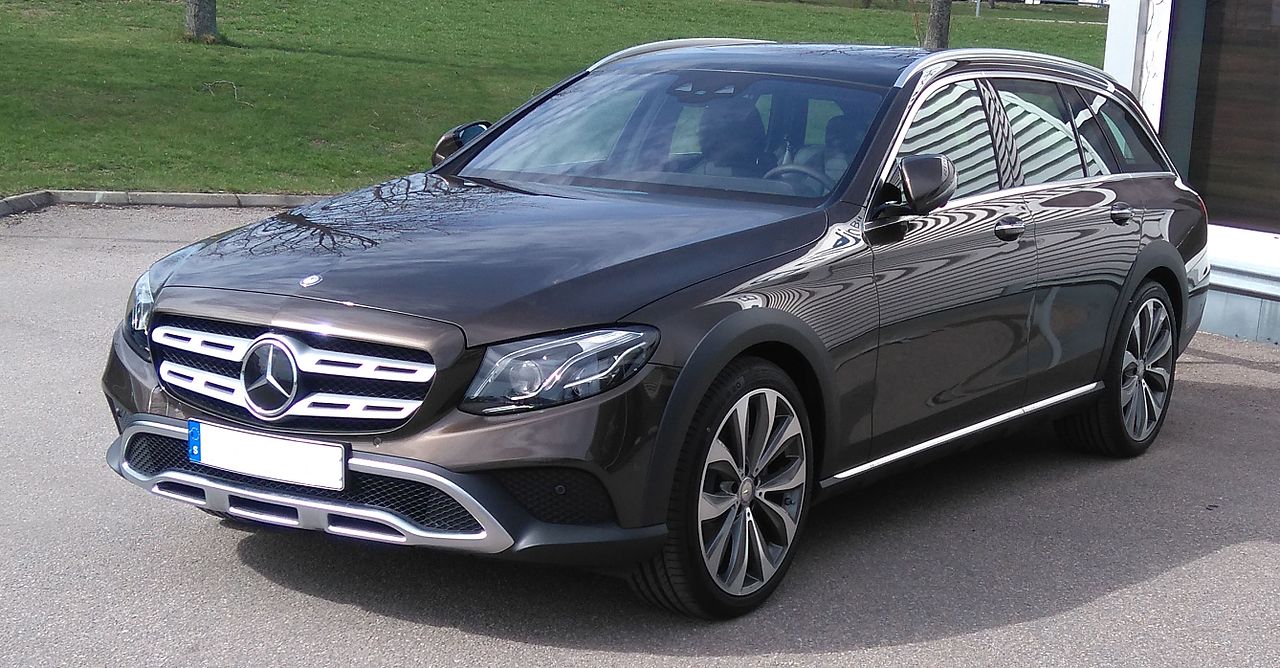
Mercedes E-class All-Terrain

Likes: It's posh and comfortable to drive. It's elegant and classy styling is matched with rugged 4-matic all-wheel-drive system.

Dislikes: Audi diesel engines are smoother. Volvo V90 Cross-country is cheaper and just as elegant. How many people are really going to take this thing off-road?

Overall: The perfect alternate to luxury 4x4s.


Audi A6 Allroad

Likes: The diesel engines are just dandy to live with and drive. The interior is so posh and comfortable. It's classy to look at and drive.

Dislikes: The pedals are off-set making it quite odd to drive.

Overall: It's a classy 'lifted-wagon' that's slowly winning our hearts.


Thursday, November 17, 2022

Smart Forfour

The Smart Forfour (stylized as "smart forfour") is a city car (A-segment) marketed by Smart over two generations. The first generation was marketed in Europe from 2004 to 2006 with a front-engine configuration, sharing its platform with the Mitsubishi Colt. The second generation was marketed in Europe from 2014 after an eight-year hiatus, using rear-engine or rear electric motor configurations. It is based on the third-generation Renault Twingo, which also forms a basis for the third-generation Smart Fortwo. A battery electric version was marketed as the EQ Forfour beginning in 2018. Petrol-powered Forfour was discontinued in 2019 as production of all Smart internal combustion models ended at that time. Production of the EQ Forfour ended in 2021. It was indirectly replaced by the larger Smart #1 crossover.
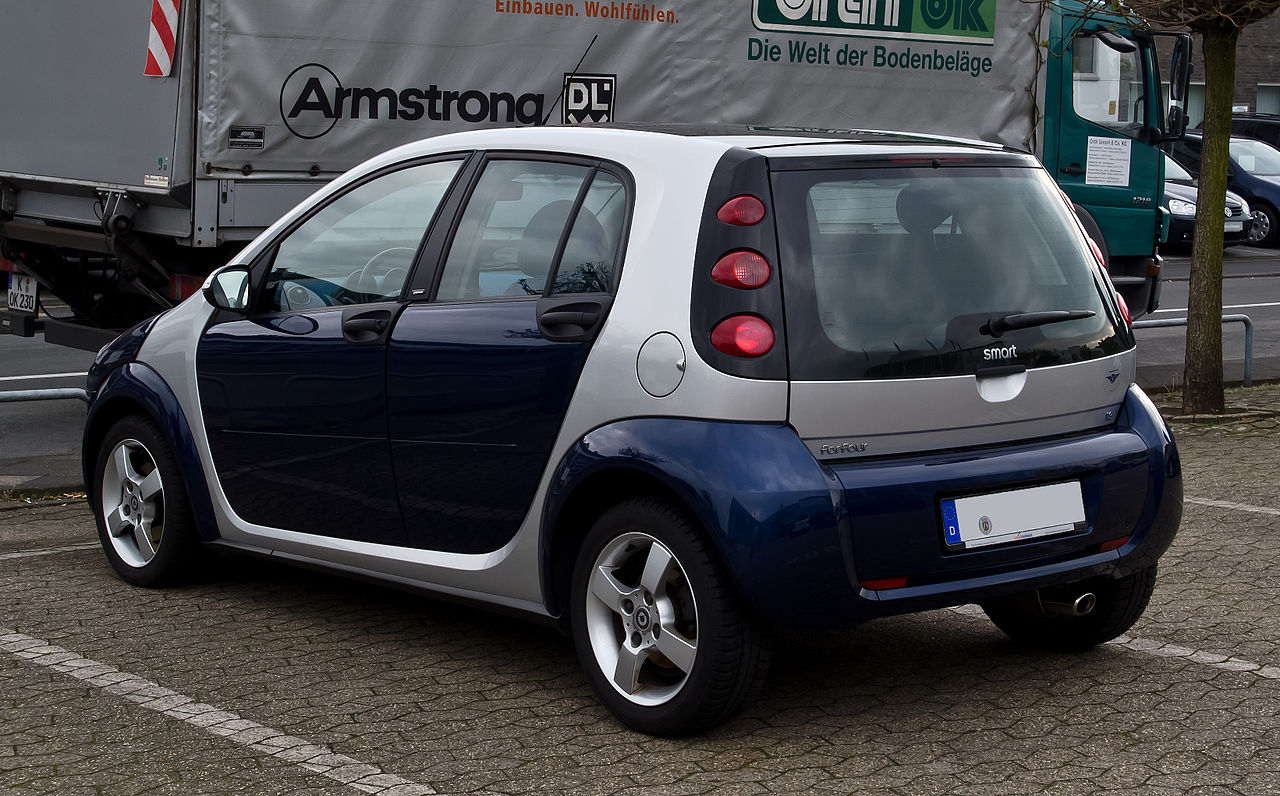
The car was produced at the NedCar factory in the Netherlands in conjunction with Mitsubishi Motors. This is the same factory that produced Volvo 300 in the 1970s and 1980s and the Volvo S40 in the 1990s. To save production costs, the Smart Forfour shared almost all of its components with the 2003 Mitsubishi Colt. This includes the chassis, suspension and a new generation of MIVEC petrol engines, ranging from the three-cylinder 1.1 L (67 in3) to the four-cylinder with power up to 80 kW (109 PS; 107 hp). The Smart Forfour was phased out from production in 2006 due to slow sales. Equipment Depending on the version, it came equipped with ESP, ABS (standard on all models), 14-inch or 15-inch alloy wheels or, optional, 16-inch ones (17-inch on the Brabus model), safety cell, a panoramic sunroof (or, optional, electric sunroof), height-adjustable driver seat, illuminated glove box, radio/CD-player, fog lights, front and side airbags (standard on all models), alarm, automatic air conditioning, electric front windows, and as options - multifunctional steering wheel, shift paddles, heated front seats, lounge seats, navigation and color display with telephone keypad or DVD navigation with a larger display, CD changer, window bags, rain sensor, automatic lights on the system (in poor visibility), leather package. Marketing The sales brochures state that the interior "is designed around the concept of a lounge"; to test this, Top Gear presenters spent 24 hours inside the Forfour. They said they would not buy the car due to its high price and poor driving dynamics compared to its rivals. Following Smart's initial success for the fortwo in the U.S., and due to surprisingly high popularity in the Forfour, former Mercedes-Benz exec Rainer Schmückle revealed that officials were considering relaunching the car. Forfour Brabus (2005) Forfour Brabus is a version of Smart Forfour tuned by Brabus with a turbocharged Mitsubishi 4G15 engine rated 130 kW (177 PS; 174 hp), 27 PS (20 kW; 27 hp) more than the Mitsubishi Colt CZT. It can reach a maximum speed of 221 km/h (137 mph) and accelerate from zero to 100 km/h (62 mph) in 6.9 seconds.
1.0 12v M134 E11 red. I3 1,124 cc 47 kW (64 PS; 63 hp) at 5500 rpm 92 N⋅m (68 lb⋅ft) at 2500 rpm 158 km/h (98 mph) 15.3 s 6.9 l/100 km (41 mpg‑imp) 128 g/km 2005–2006 1.1 12v M134 E11 I3 1,124 cc 55 kW (75 PS; 74 hp) at 6000 rpm 100 N⋅m (74 lb⋅ft) at 3500 rpm 165 km/h (103 mph) 13.4 s 7.0 l/100 km (40 mpg‑imp) 130 g/km 2004–2006 1.3 16v M135 E13 I4 1,332 cc 70 kW (95 PS; 94 hp) at 5250 rpm 125 N⋅m (92 lb⋅ft) at 4000 rpm 180 km/h (112 mph) 10.8 s 7.4 l/100 km (38 mpg‑imp) 138 g/km 2004–2006 1.5 16v M135 E15 I4 1,499 cc 80 kW (109 PS; 107 hp) at 6000 rpm 145 N⋅m (107 lb⋅ft) at 4000 rpm 190 km/h (118 mph) 9.8 s 7.8 l/100 km (36 mpg‑imp) 145 g/km 2004–2006 1.5 16v Brabus M122 E15 AL I4 turbo 1,468 cc 130 kW (177 PS; 174 hp) at 6000 rpm 230 N⋅m (170 lb⋅ft) at 3500 rpm 221 km/h (137 mph) 6.9 s 6.9 l/100 km (41 mpg‑imp) 159 g/km 2005–2006 Diesel engines 1.5 12v cdi 50 kW OM639 DE15 LA red. I3 1,493 cc 50 kW (68 PS; 67 hp) at 4000 rpm 160 N⋅m (118 lb⋅ft) at 1800 rpm 160 km/h (99 mph) 13.9 s 5.8 l/100 km (49 mpg‑imp) 121 g/km 2004–2006 1.5 12v cdi 70 kW OM639 DE15 LA I3 1,493 cc 70 kW (95 PS; 94 hp) at 4000 rpm 210 N⋅m (155 lb⋅ft) at 1800 rpm 180 km/h (112 mph) 10.5 s 5.8 l/100 km (49 mpg‑imp) 121 g/km 2004–2006 The 1.5 L (92 in3) common direct injection (cdi) diesel engine, is a three-cylinder Mercedes-Benz engine derived from the four-cylinder used in the Mercedes-Benz A-Class, and is available with either 68 PS (50 kW; 67 hp) or 95 PS (70 kW; 94 hp). Transmissions All models could be equipped with either a 5-speed manual or a 6-speed automatic (Softouch) transmission, except the 1.0-liter version and the Brabus version, which could only use 5-speed manual transmissions.
The second-generation Forfour was jointly developed with Renault, reportedly sharing approximately 70% of its parts with the third-generation Renault Twingo, while retaining the trademark hemispherical steel safety cell, marketed as the Tridion cell. The Fortwo is assembled at Smartville, and the Forfour is manufactured alongside the Renault Twingo 3 in Novo Mesto, Slovenia. Smartville, where the W450 and W451 build series have been manufactured, underwent a 200 million euro upgrade beginning in mid-2013, in preparation for the C453 Fortwo. The second generation Forfour, along with the new Fortwo went on sale in October, shortly after their debuting at the Paris Motor Show The Smart Fortwo and Forfour is offered with a choice of manual transmission or double-clutch automatic — and no longer with the Getrag automated manual. Both models feature a wider track, overall width increased by 10 cm (over the second generation Fortwo), improved ride and improved noise isolation. For the third generation, Autoweek projected that Daimler consulted with Ford to learn about Ford's 1.0-litre turbocharged inline 3-cylinder engine, in turn sharing information about its own Euro 6 stratified lean-burn gasoline engines. The launch model "edition #1" was a limited period version, presented in Tempodrom, Berlin. Delivery is scheduled to commence in November 2014 with the Forfour 52 kW and 66 kW models to follow in December 2014, and twinamic dual-clutch transmission models in the spring of 2015.
Smart Fourjoy concept includes Smart's signature Tridion cell in polished full-aluminium, tail lights integrated in the Tridion cell, spherical instrument cluster, raised smart lettering milled from aluminium on the side skirts, pearlescent white on the bumpers, front bonnet and tailgate; headlamps without a glass cover, U-shaped daytime running lights, LED front and tail lights, transparent petroleum-coloured moulded wind deflector at the top of the front windscreen, on the A-pillars on the sides and on the rear roof spoiler; rear dark chrome seats, a piping-like line with the same petroleum colour as the plexiglass accents on the exterior, instrument panel with convex surface and touch-sensitive operating functions, spherical instrument cluster, single-spoke steering wheel, two smartphones mounted on the dashboard and on the centre tunnel, 55 kW magneto-electric motor, 17.6kWh lithium-ion battery, 22 kW onboard charger, two electrically driven skateboards on the roof, helmets under the rear seats, a high-definition camera. The vehicle was unveiled at the 2013 Frankfurt Auto Show (without doors and roof). A concept version, never manufactured, of the Smart Forfour was converted as a plug-in hybrid by third-party vendors. The lithium-ion battery can propel the vehicle up to 84 mph (135 km/h) and last on its own for up to 20 miles (32 km) with an engine that combined a 68 hp (51 kW; 69 PS), 1.5 L (92 in3), three-cylinder turbocharged diesel engine and two high-efficiency permanent-magnet electric motors. It received an award from the Energy Saving Trust for the "Ultra Low Carbon Car Challenge" project.
In 2013, Daimler projected it would produce an electric version of the Smart Forfour during the second generation of production, for launch in 2015. The battery-electric smart forfour electric drive entered mass-production in 2017 at Renault's Novo Mesto plant in Slovenia and was marketed in Europe, competing with other electric city cars such as the MG ZS EV, Renault Twingo Z.E (with which it shares many components), and Volkswagen E-up!, including the SEAT Mii electric and Škoda Citigo-e iV, rebadged versions of the E-up!. In 2019, it was restyled and rebranded to Smart EQ ForFour, after Chinese automobile manufacturer Geely took a stake in Daimler, becoming a 50–50 partner in Smart, and Smart pivoted to market electric cars only. The EQ ForFour was discontinued in early 2022. It used a rear-mounted 60 kW (80 hp) electric motor with a peak torque of 160 N⋅m (120 lbf⋅ft) and is fitted with a 17.6 kW-hr battery. The EQ Forfour has a rated consumption of 13.1 kWh/100 km (combined) and achieves 160 km (99 mi) range using the NEDC test cycle, dropping to 130 km (81 mi) on the WLTP cycle. As tested, Autocar had a range of 109 km (68 mi), using "a gentle touring driving style", dropping to 80 km (50 mi) when not driving as carefully. The kerb weight of the electric forfour is 1,200 kg (2,600 lb), approximately 225 kg (496 lb) heavier than an equivalent petrol-powered forfour. Model Years Type/code Power, torque@rpm Forfour 45 kW 2015–2017 999 cc (61.0 cu in) I3 60 PS (44 kW; 59 hp)@?, ?@? Forfour 52 kW 2014–2019 999 cc (61.0 cu in) I3 71 PS (52 kW; 70 hp)@?, 91 N⋅m (67 lbf⋅ft)@2850 Forfour 66 kW 2014–2019 898 cc (54.8 cu in) I3 turbo 90 PS (66 kW; 89 hp)@?, 135 N⋅m (100 lbf⋅ft)@2500 Forfour Brabus 2016–2018 898 cc (54.8 cu in) I3 turbo 108 PS (79 kW; 107 hp)@?, 175 N⋅m (129 lbf⋅ft)@2500 Electric motor Model Years Type/code Power, torque@rpm EQ Forfour 2017–2021 synchronous electric motor 82 PS (60 kW), 160 N⋅m (118 lbf⋅ft)

Friday, May 4, 2018

History of Smart Forfour

2005 Smart Forfour Pulse 1.1.jpg

The Smart Forfour is a supermini presented and produced by Smart over two generations. The first generation was marketed in Europe from 2004 to 2006 (four door, front engine) and the second generation was marketed in Europe from 2014 onwards (four door, rear engine).

The first generation Forfour was marketed only in Europe from 2004 to 2006 and in Australia as a 4-door, 5-seat hatchback, sharing its platform with the Mitsubishi Colt. After an eight-year hiatus, the second generation Forfour debuted in July 2014, sharing its platform with the forthcoming third generation Renault Twingo (four door, rear engine) and mechanicals with the third generation Smart Fortwo (two door, rear engine).

Forfour Brabus is a version of Smart Forfour with a turbocharged Mitsubishi 4G15 engine rated 130 kW (177 PS; 174 hp), 27 PS (20 kW; 27 hp) more than the Mitsubishi Colt CZT. The Brabus Forfour requires higher than standard octane fuel to develop full power. It can reach a maximum speed of 221 km/h (137 mph) and accelerate from zero to 100 km/h (62 mph) in 6.9 seconds. The Forfour was to be sold in the United States along with the revived Smart Formore vehicle.


The car was produced at the NedCar factory in the Netherlands in conjunction with Mitsubishi Motors. This is the same factory that produced Volvo 300s in the 1970s and 1980s and the Volvo V40s in the 1990s. To save production costs, the Smart Forfour shared almost all of its components with the 2003 Mitsubishi Colt. This includes the chassis, suspension and a new generation of MIVEC petrol engines, ranging from the three cylinder 1.1 L (67 in3) to the four cylinder with power up to 80 kW (109 PS; 107 hp).

The Smart Forfour was phased out from production due to slow sales.

The sales brochures state that the interior "is designed around the concept of a lounge"; to test this, Top Gear presenters spent 24 hours inside the Forfour. They said they would not buy the car due to its high price and poor driving dynamics compared to its rivals.

Following Smart's initial success for the fortwo in the US, and due to a surprisingly high popularity in the Forfour, former Mercedes-Benz exec Rainer Schmückle revealed that officials were considering relaunching the car.

Smart Forfour 1.0 Edition 1 (W 453) – Frontansicht, 15. März 2015, Düsseldorf.jpg

The second generation Forfour is jointly developed with Renault. Motor Trend reported the second generation Forfour shares approximately 70% of its parts with the third generation Renault Twingo. Smart CEO Annette Winkler has reported that the W453 will retain the second Generation Fortwo trademark hemispherical steel safety cell, marketed as the Tridion cell. The Fortwo will continue to be assembled at Smartville, and the Forfour will be manufactured alongside the Renault Twingo 3 in Novo Mesto, Slovenia. Smartville, where the W450 and W451 build series have been manufactured, underwent a 200 million euro upgrade beginning in mid-2013, in preparation for the C453 Fortwo. The new Forfour, along with the new Fortwo is set to go on sale in October, shortly after their public reveals at the Paris Motor Show.

According to chief development engineer for the C453/W453, Markus Rieder (who had previously worked on development of the Mercedes ML and GL SUV's), the Smart Fortwo and ForFour will be offered with a choice of manual transmission or double-clutch automatic — and nolonger with the Getrag automated manual. According to Rieder, both models will feature a wider track, overall width increased by 10 cm (over the 2nd generation Fortwo), improved ride and improved noise isolation.

For the forthcoming third generation, Autoweek reported that Daimler consulted with Ford to learn about Ford's 1.0 Liter turbo-charged inline 3-cylinder engine, in turn sharing information about its own Euro6 stratified lean-burn gasoline engines.

The launch model "edition #1" is a limited period version, unveiled in Tempodrom, Berlin. Delivery is scheduled to commence in November 2014 with the Forfour 52 kW and 66 kW models to follow in December 2014, and twinamic dual clutch transmission models in the spring of 2015.

Smart Fourjoy concept includes Smart's signature tridion cell in polished full-aluminium, tail lights integrated in the tridion cell, spherical instrument cluster, raised smart lettering milled from aluminium on the side skirts, pearlescent white on the bumpers, front bonnet and tailgate; headlamps without a glass cover, U-shaped daytime running lights, LED front and tail lights, transparent petroleum-coloured moulded wind deflector at the top of the front windscreen, on the A-pillars on the sides and on the rear roof spoiler; rear dark chrome seats, a piping-like line with the same petroleum colour as the plexiglass accents on the exterior, instrument panel with convex surface and touch-sensitive operating functions, spherical instrument cluster, single-spoke steering wheel, two smartphones mounted on the dashboard and on the centre tunnel, 55 kW magneto-electric motor, 17.6kWh lithium-ion battery, 22 kW on-board charger, two electrically driven skateboards on the roof, helmets under the rear seats, a high-definition camera.

The vehicle was unveiled at the 2013 Frankfurt Auto Show (without doors and roof).

A Smart Forfour has been converted into a plug-in hybrid by Lithium Technology Corporation and Zytek Systems. The lithium-ion battery can propel the vehicle up to 84 mph (135 km/h) and last on its own for up to 20 miles (32 km). The engine is a combination of a 68 hp (51 kW; 69 PS), 1.5 L (92 in3), three-cylinder turbocharged diesel engine and two high-efficiency permanent-magnet electric motors. It received an award from the Energy Saving Trust for the "Ultra Low Carbon Car Challenge" project.

Daimler has confirmed it will produce an electric version of the Smart Forfour during the second generation of production. Production is expected in 2014, as a 2015 model year.

As of 2018 an only electric Smart ForFour is available (aka smart forfour electric drive). It is using a 60 kW electric motor with 13.1 kWh/100 km power consumption (combined) and 160 kilometre range.

Sunday, December 3, 2017

What we'd like to see (part two)


Mazda Speed 3 (Please!)

Mazda has confirmed that the 2.5-turbo four-cylinder from the CX-9 can fit in practically fit in the Mazda6 and Mazda3. With that being said, it would be pretty cool to see this engine optional through out the range. Which means that a Speed 3 could be make a much wanted comeback seeing that there's a lot of competition from the Focus ST/RS and Honda Civic SI/Type-R. We're just saying Mazda, if Honda is making cool cars again with the new high performance versions of the Civic. The Mazda 3 needs to step its game up with the Speed 3 variant pushing between 250 to 300hp would be ideal.

Note: The Mazda 6 will get the 2.5-turbo engine with its refresh for 2019. Also, the CX-5 is going to get a turbo-diesel engine option. 


2017 Kia Optima 3 Sportswagon Front.jpg

Kia Optima (wagon or lifted-crossover-like-wagon)

We know we sound like a broken record but we thoroughly enjoyed the Kia Optima Wagon that we drove while overseas. What we loathe the most is that diesel engine, it had the torque which made it feel lively around town but it loses steam quite quickly and is not very refined. With that being said, Kia should bring the Optima here in either the wagon form or lifted-crossover-like-wagon to compete with the Subaru Outback. It would be nice to see this stylish wagon brought to our shores with all three engine options and standard all-wheel-drive. We'd spend our money on a Kia Optima crossover wagon if offered.

2015 MINI Cooper Hardtop 2 door -- NHTSA test 9062 - front.jpg

Mini 3-door Hardtop (Cooper SD)

We know that diesel engines get bad rep here and it would be particularly expensive to bring one here. However, it still doesn't mean we can't wish for one. The 2-liter diesel from the 3-series could be placed in Minis line-up and offer a relatively inexpensive diesel engine option for our shores. It would be quite interesting to see Mini offer such an engine here, especially since Volkswagen no longer sells TDI engines here.

Smart Forfour 1.0 Edition 1 (W 453) – Frontansicht, 15. März 2015, Düsseldorf.jpg

Smart Forfour

Smart has discontinued the 1-liter turbo three-cylinder from the Fortwo Range due to low sales. You can still buy a Fortwo but only EV (electric vehicle) configuration. What we find even more interesting is that Smart isn't selling the larger Forfour here. It would be nice to see a four seat version of Smart sold here, however the price tag would be way too expensive for most tastes and that 0.9 turbo engine is very laggy and tricky to drive. Mini has the market almost to its self at this point, mainly due to BMW origins so it has the classy image and driving dynamics that Mini is known for. The Forfour has the quirky charm but won't translate well here in the US but it would still be nice to see this little hatch here on our shores.